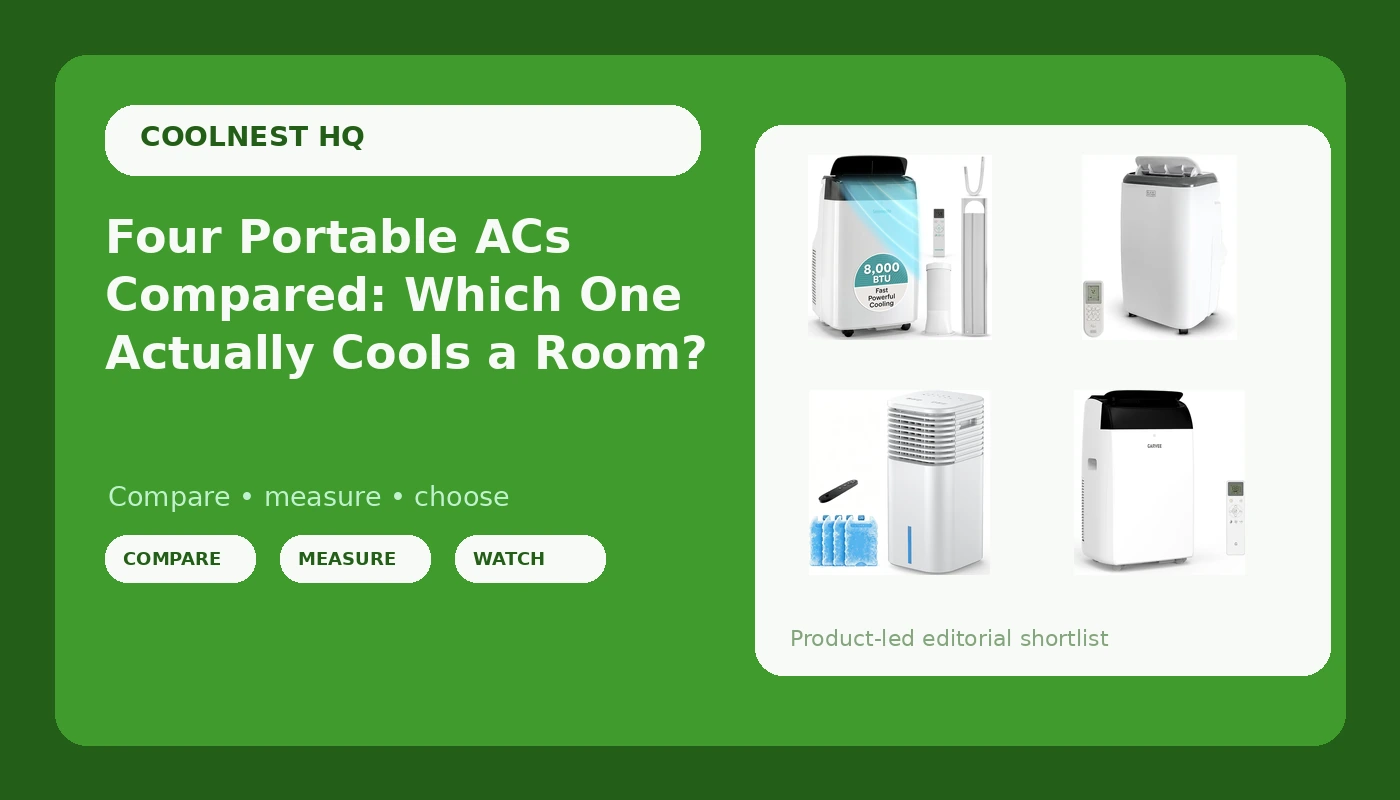
Portable air conditioners are the most oversold appliance in home cooling, and I say that as someone who has spent 18 years fixing the equipment they compete with. I live in Phoenix, where a July afternoon hits 115°F, and I have watched a lot of people buy a box that promised 12,000 BTU and get a fan with a hose attached. This portable air conditioner comparison sorts four current units by the things that actually decide whether you sleep at night: hose design, condensate handling, noise, and whether the unit is even a real air conditioner. Two of these are honest compressor units. One is a compromise. One is an evaporative cooler wearing an air conditioner's badge, and that distinction is the most important thing on this page.
For a large room, the Garvee 14,000 BTU 3-in-1 is where I would start, because it is the only unit here claiming enough capacity to matter past a small bedroom, and it includes a window kit. The SereneLife 8,000 BTU is the safer pick for a bedroom. The BLACK+DECKER 7,500 BTU is the budget floor. The 3-IN-1 windowless unit is not an air conditioner at all, and I will explain exactly what it is and who should buy it anyway.
The four units side by side
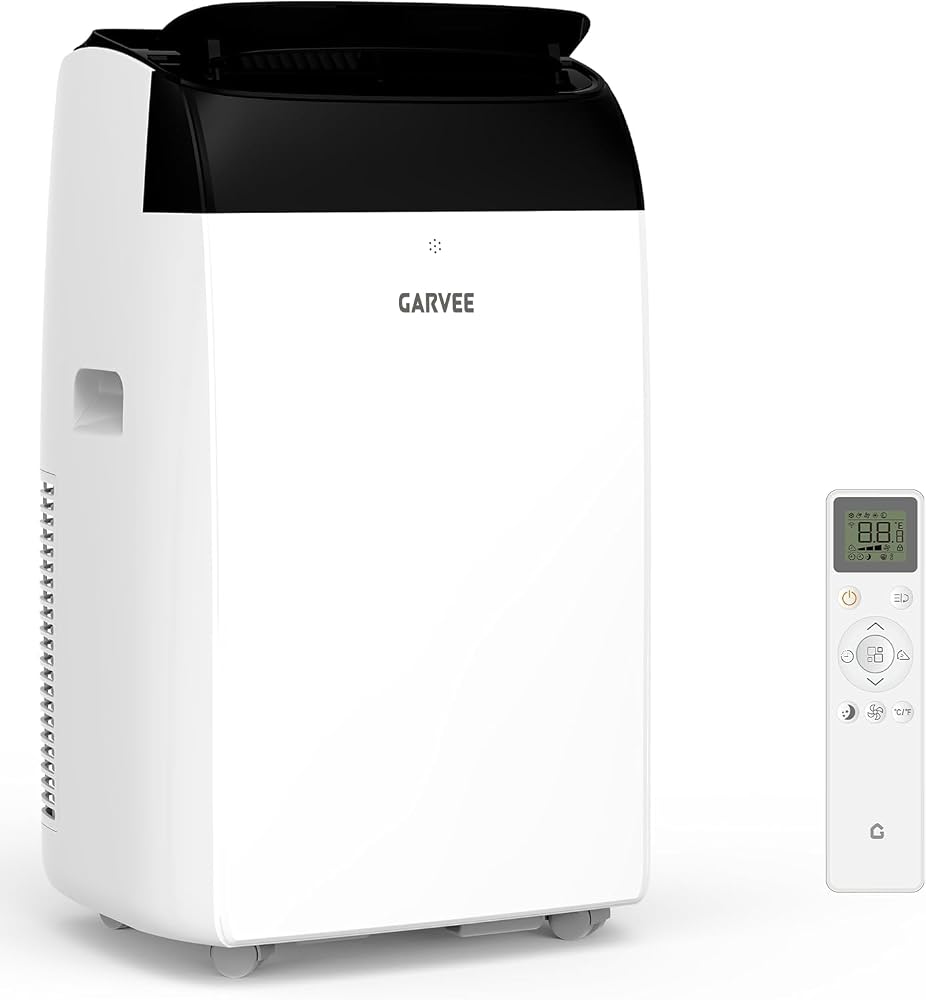
Garvee 14,000 BTU 3-in-1 Portable Air Conditioner
Highest stated capacity here, cooling plus dehumidifier plus fan, ships with a window kit, sleep mode and 24-hour timer
The 750 sq ft claim is optimistic for a portable, no dual-hose design is mentioned, and big portables are heavy and loud
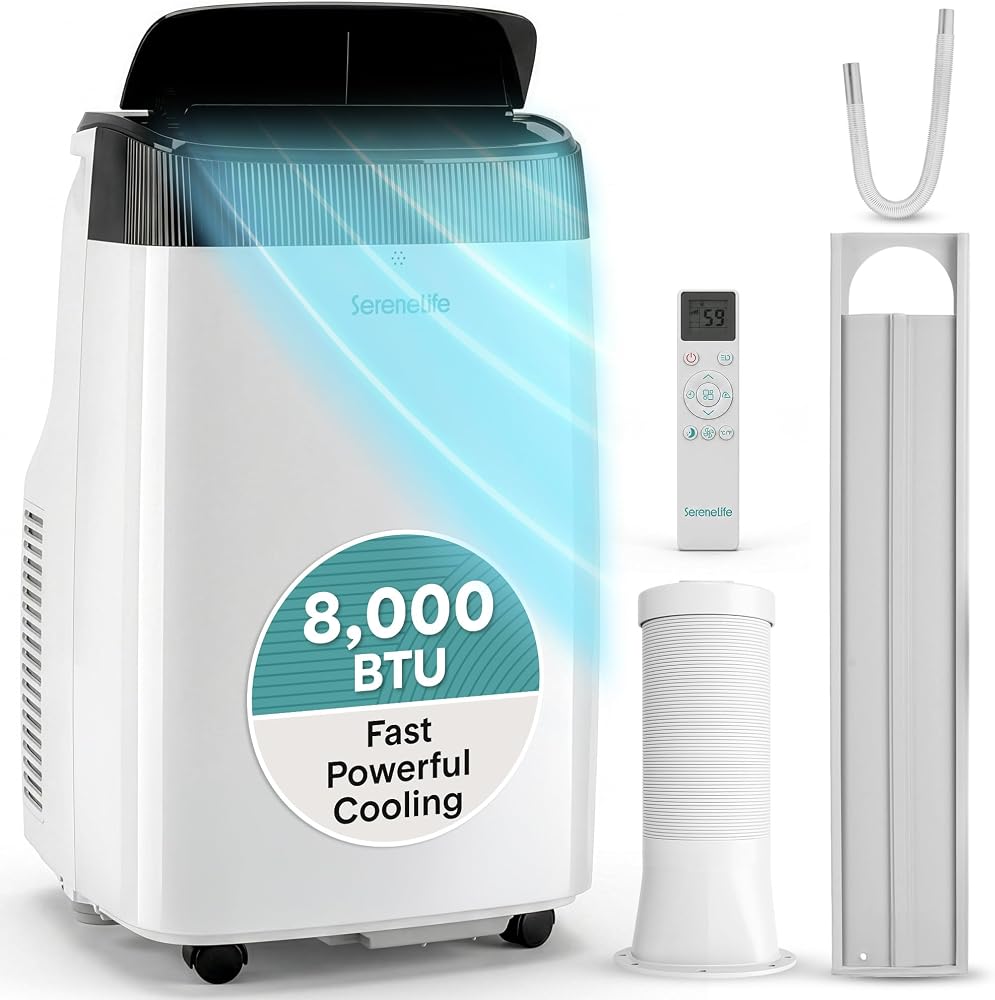
SereneLife 8,000 BTU Portable Air Conditioner
Realistic bedroom capacity, dehumidifier and fan modes, three fan speeds, remote, window exhaust kit, setpoint range of 64°F to 90°F
"Dual motor" is not "dual hose," so the exhaust design is likely single hose, and the install is fussier than the marketing suggests
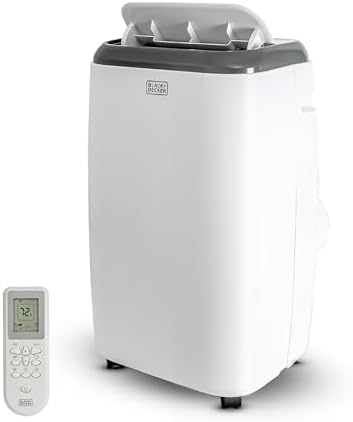
BLACK+DECKER 7,500 BTU Portable Air Conditioner, BPT05WTB
Smallest and simplest of the compressor units, known brand, easy to explain to a landlord, sensible for a single bedroom
Lowest capacity in this group, thinnest feature list, no dehumidifier mode named, and 7,500 BTU does not stretch past one small room
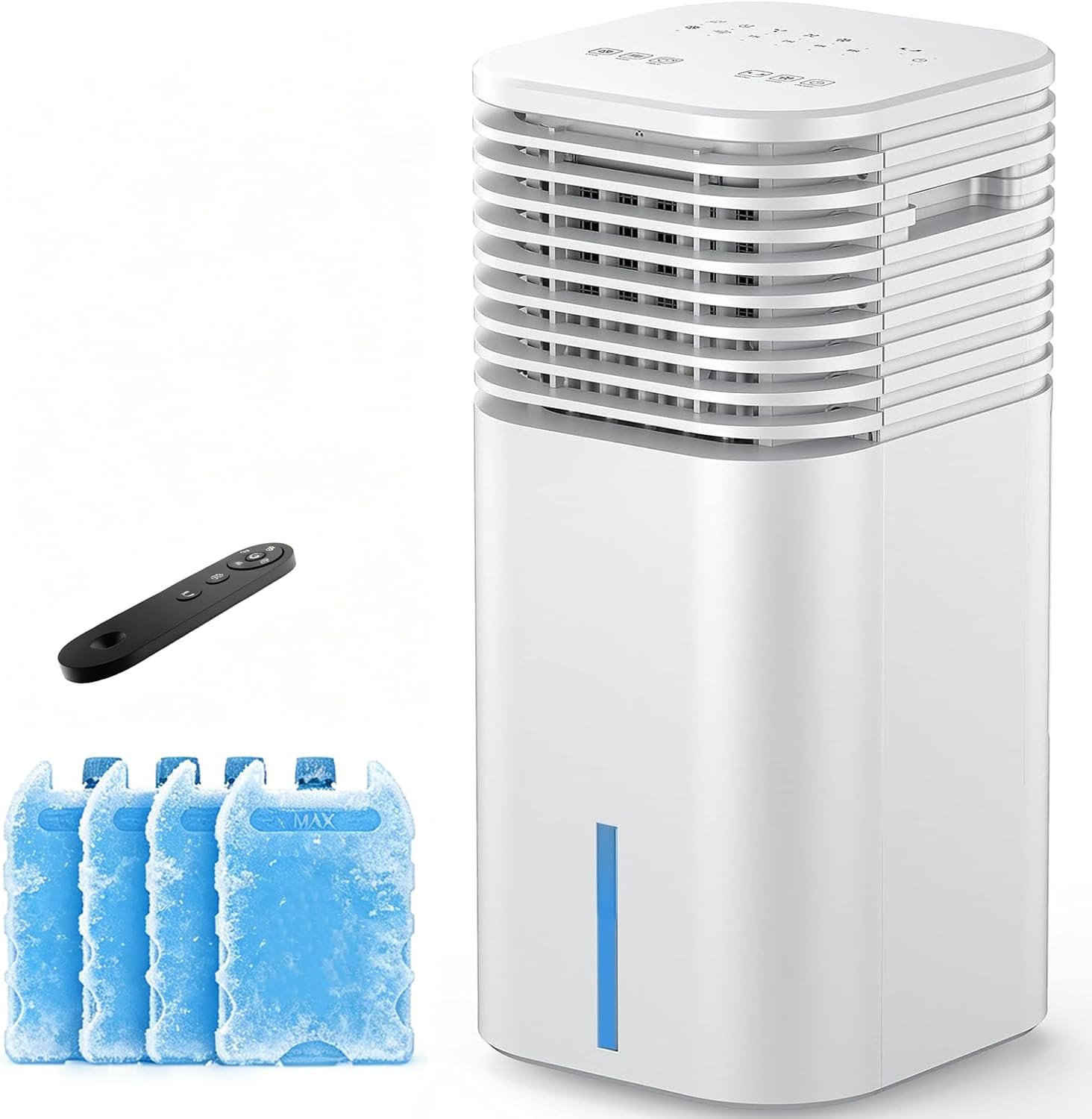
3-IN-1 Windowless Portable Air Conditioner with Remote
No window required, genuinely quiet because there is no compressor, 2-gallon tank, 15-hour timer, 120-degree oscillation, lowest cost here
It is an evaporative swamp cooler, not a refrigerant air conditioner: it adds humidity, needs water refills, and cannot cool a sealed room
Prices and availability were captured from Amazon Creators API and may change.
Start by asking what these units actually are
There are two different machines in that table, and the marketing language blurs them on purpose. Three of these are compressor-driven air conditioners: they move refrigerant, they pull heat out of the room air, and they dump that heat outside through an exhaust hose. One of them is an evaporative cooler: it pulls room air across a wet pad, the water evaporates, and the air comes back cooler and more humid. No compressor, no refrigerant, no hose.
That is not a knock on evaporative cooling. In dry heat, a swamp cooler is one of the most efficient ways to cool a space, and it uses a fraction of the electricity a compressor does. But it is a completely different tool with completely different rules, and the listing that calls it a "windowless portable air conditioner" is leaning on a category name rather than describing the physics.
The windowless 3-IN-1 is a swamp cooler, and that changes everything
Look at the giveaway words in the name: ventless, windowless, swamp cooler, 2-gallon tank, 120-degree oscillation. A tank and oscillation are the signature of an evaporative unit. It holds water, blows air across it, and oscillates the cooled air around the room. There is no window kit because there is nothing to exhaust. There is no drain because it is not removing condensate, it is adding moisture.
What that means in practice:
- It needs a supply of water. A 2-gallon tank is a real chore in a dry climate, because evaporative cooling consumes water fast in low humidity. Plan on refills, and plan on them more often than you would like during a heat wave.
- It adds humidity to the room. In Phoenix in June, that is fine. In Phoenix during monsoon season, or in Houston, or in a basement, you are making the air wetter while trying to feel cooler. Humidity is what makes heat miserable in the first place.
- It cannot cool a sealed room. Evaporative cooling needs airflow and dry air. Close the door and run it in a small sealed bedroom and you get a damp, lukewarm room.
- It has one genuine advantage: noise. No compressor means no compressor noise. The "ultra-quiet" claim in the listing is believable for this class of machine in a way it never is for a real portable AC. If your only complaint about your last portable was the racket, this is the quietest thing on this page.
- It is the cheapest way to move air in a room where you cannot install anything. No window, no landlord permission, no exhaust hose hanging out of a sash.
If you are in a dry climate, cooling a garage, a workshop, or a covered patio with the doors open, this is a reasonable buy. If you are trying to hold a bedroom at 72°F with the door shut in August, this unit cannot do it, and no timer or oscillation setting changes that.
BTU numbers, and the rating that matters more
Here is the thing I explain to customers more than anything else: the BTU figure on the box is not the cooling you get. Since the DOE changed the test standard for portables, the honest number is the SACC rating, and on many units it lands at roughly half the marketing number. A "12,000 BTU" portable that measures out around 6,500 SACC is not lying, exactly. It is quoting a different test.
So when the Garvee listing says 14,000 BTU and rooms up to 750 sq ft, treat the BTU as a starting point and the square footage as a best case with the door open and the sun off the room. Same with the SereneLife at 8,000 BTU and the BLACK+DECKER at 7,500 BTU. Those are reasonable numbers for a bedroom. None of them is a central air replacement.
My rule of thumb for portables, after measuring too many of them with a thermometer instead of trusting the sticker: size for about 250 to 350 square feet per 8,000 BTU of marketing rating, in a room with normal ceiling height and normal windows. If your room is bigger than that, you want the biggest unit you can afford, and you want it installed properly.
Hose design decides whether the unit fights itself
This is the spec almost nobody prints on the box, and it matters more than the BTU number in most rooms.
A single-hose portable pulls air from inside your room, runs it across the condenser, and blows it out the window. That air has to be replaced, and it gets replaced by hot outdoor air seeping in through every gap in the house. The unit is cooling your room while the house sucks in heat to make up the difference. A dual-hose unit pulls outdoor air in for the condenser and dumps it back out, so it does not depressurize your house.
None of the four units here advertises a dual-hose design. The SereneLife name says "dual motor," which is about the fan and compressor motors, not about two hoses. That is a marketing phrase, not a hose count. Assume all three compressor units here are single hose unless the listing says otherwise in plain language.
What that means: install the window kit properly and seal the gap. The exhaust hose should be short, straight, and not coiled in the room. Every foot of slack hose is heat radiating back into the space you paid to cool. If you can shorten the run, shorten it.
Condensate is the spec that decides your summer
A portable AC pulls water out of the air. The question is where that water goes, and the answer decides whether you own an appliance or a chore.
The Garvee and the SereneLife both list dehumidifier modes, which is the tell that they will be pulling meaningful moisture. If a unit only has a small internal tank and no continuous drain port, you are emptying a bucket, and in a humid climate that can be several times a day. Before buying, look for a gravity drain or hose drain option. If the listing does not say, ask. This is the single most common reason people stop using a portable AC by mid-July.
The 3-IN-1 windowless unit is the opposite case: it is not draining anything, because it is not condensing anything. It is consuming water from its tank, which is its own kind of maintenance, just a different one.
Noise, sleep mode, and what "ultra-quiet" means
Sleep mode on a portable AC usually does two things: it dims the display and slows the fan. It does not silence the compressor. The compressor is the loud part, and it cycles on and off all night in a single-speed unit. That cycling is what wakes people up, not the fan.
So the honest ranking on noise is simple. The evaporative 3-IN-1 is the quietest, because there is no compressor to hear. The BLACK+DECKER at 7,500 BTU is next, on the general principle that smaller compressor, less noise. The Garvee, at the largest stated capacity here, will be the loudest, because moving that much heat takes a bigger compressor and a bigger fan. Sleep mode will help, but it will not make a 14,000 BTU unit disappear.
Which one for which room
- A bedroom under 300 square feet, window available: the SereneLife 8,000 BTU or the BLACK+DECKER 7,500 BTU. Both are sized for that job. I would give the edge to the SereneLife for the wider setpoint range, the three fan speeds, and the dehumidifier mode.
- A living room or open space, window available: the Garvee 14,000 BTU. It is the only unit here with the stated capacity to attempt it, and it brings the window kit.
- No window, dry climate, garage or patio: the 3-IN-1 windowless unit. This is the only scenario where it makes sense, and in that scenario it is genuinely useful.
- No window, humid climate, sealed bedroom: none of these. You need a real compressor unit and a way to exhaust it, or a window unit.
What I check before buying any portable
- The SACC rating, not the marketing BTU.
- Hose count: one or two. If it is one, plan to seal the window gap.
- Drain options: gravity port, hose port, or bucket duty.
- Window type. Crank-out and casement windows are miserable for these kits. Measure before you order.
- Return window. Buy from somewhere you can send it back, because the honest failure mode of a portable AC is that it works fine and still cannot keep up with your room.
And the thing I say to almost everyone: if your room is under 300 square feet and you have a double-hung window, a window unit will cool better, cost less, and use less power than any portable on this list. Portables exist for the rooms where a window unit cannot go. That is their whole job.
Bottom line
The Garvee 14,000 BTU 3-in-1 is the pick when you need the most cooling and you have a window for the kit. The SereneLife 8,000 BTU is the balanced bedroom choice. The BLACK+DECKER 7,500 BTU is the no-drama budget unit. And the 3-IN-1 windowless model is a quiet, cheap evaporative cooler that should be bought for what it is, in a dry climate, in a space that can breathe, and not for a sealed bedroom in July.