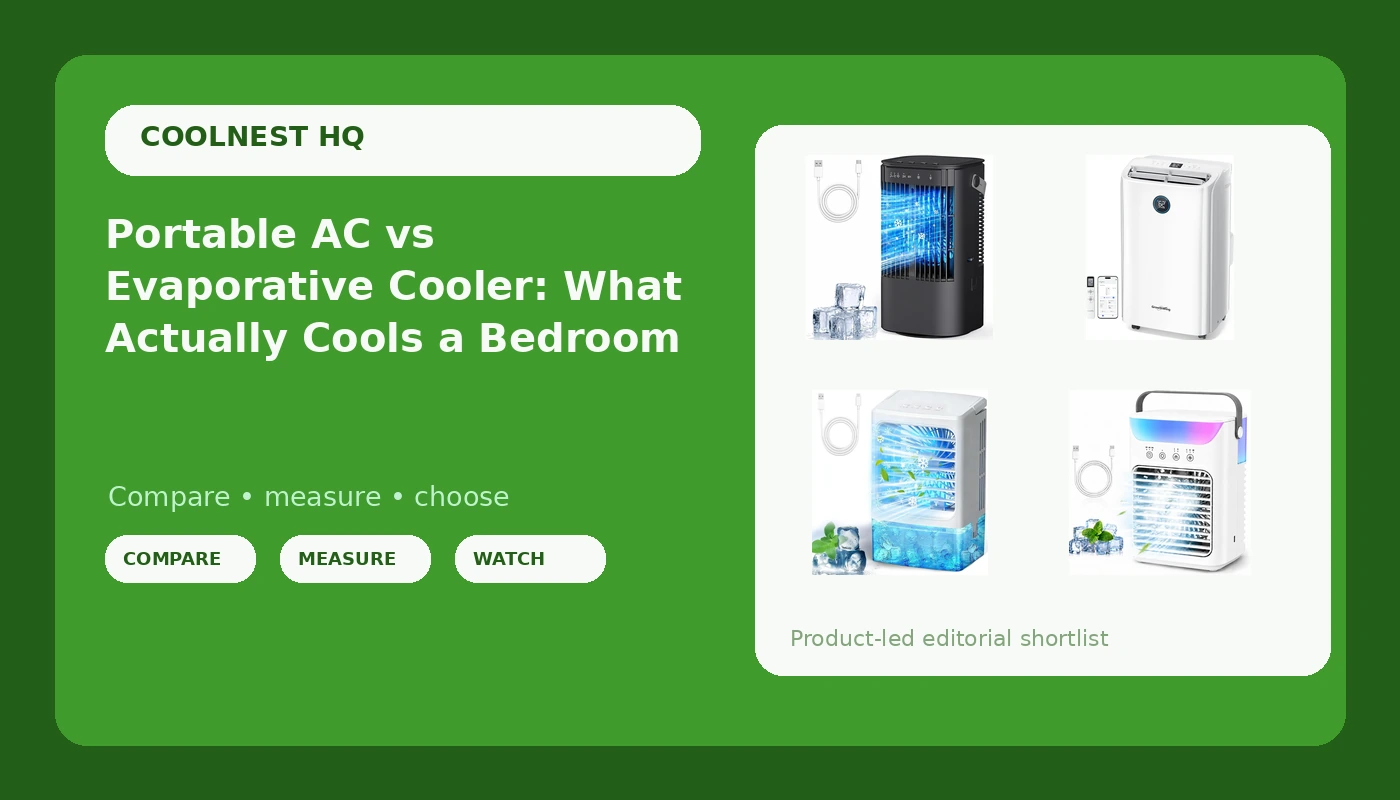
I have spent eighteen summers in Phoenix repairing cooling equipment, and every July somebody hands me a box that says "portable air conditioner" and weighs less than a gallon of milk. So when I lined up this portable AC vs evaporative cooler comparison, I already knew what I would find: three of these four products are evaporative coolers with a misting head and a light show, and one of them is an actual air conditioner with a compressor, a condenser coil, and a hose that has to go out a window. That is not a knock on the small ones. It is the single most important thing to understand before you spend money, because a swamp cooler and a compressor-driven AC do different jobs in different climates, and only one of them will hold a closed bedroom at a number on a thermostat.
If you need a room brought down to a real temperature, buy the 14,000 BTU Smart WiFi Portable Air Conditioner. If you want a personal cooling breeze on your face while you sit at a desk or sleep with air moving over you, one of the three mini units will do that job for a fraction of the money. No mini evaporative cooler will cool a room, and any listing that suggests otherwise is selling you a fan with a water tank.
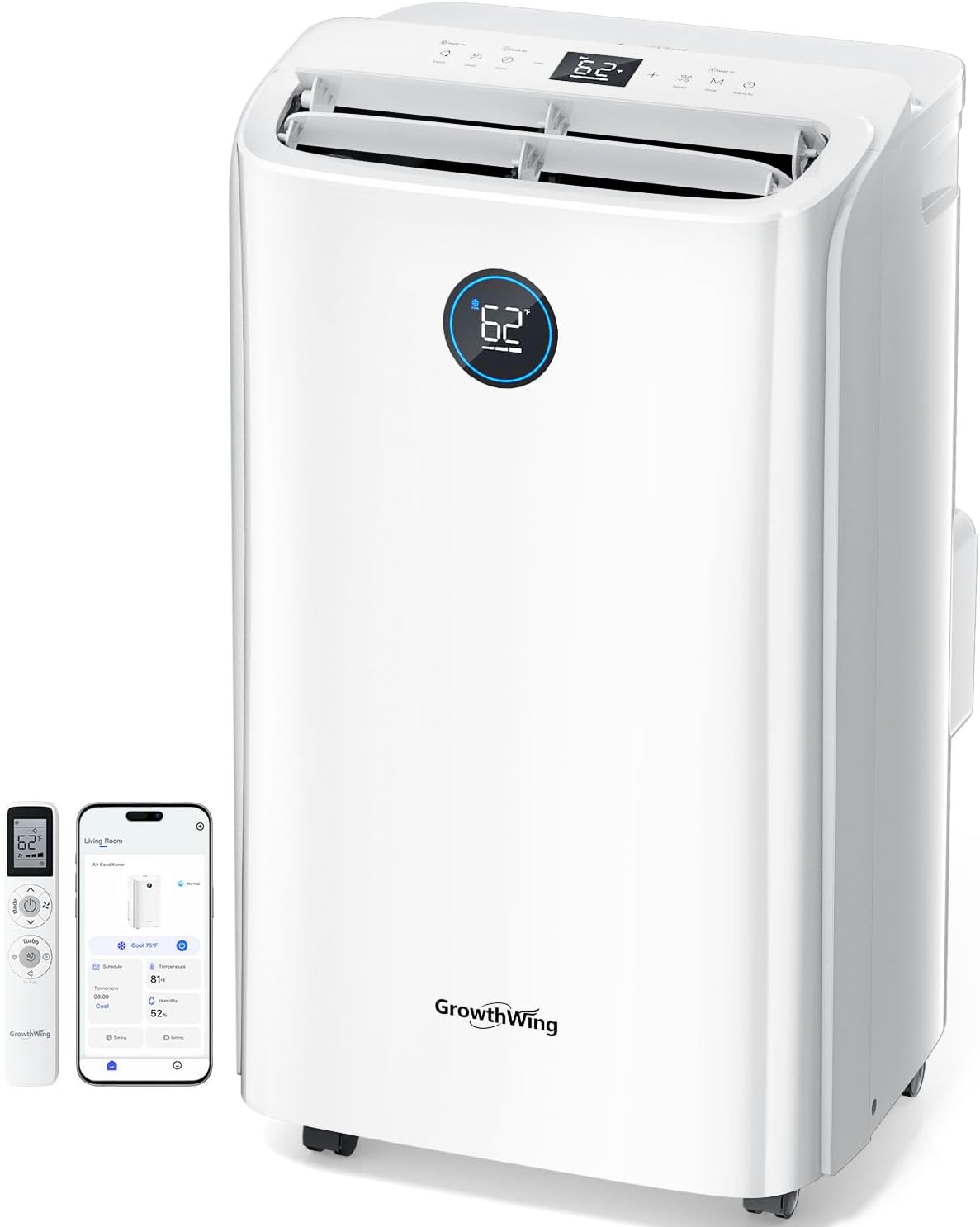
14,000 BTU Smart WiFi Portable Air Conditioner
The only unit here with a real compressor, and it adds auto-evaporation, 3-in-1 modes, WiFi, voice and remote control
Needs a window or vent path, weighs far more than the minis, and costs many times as much
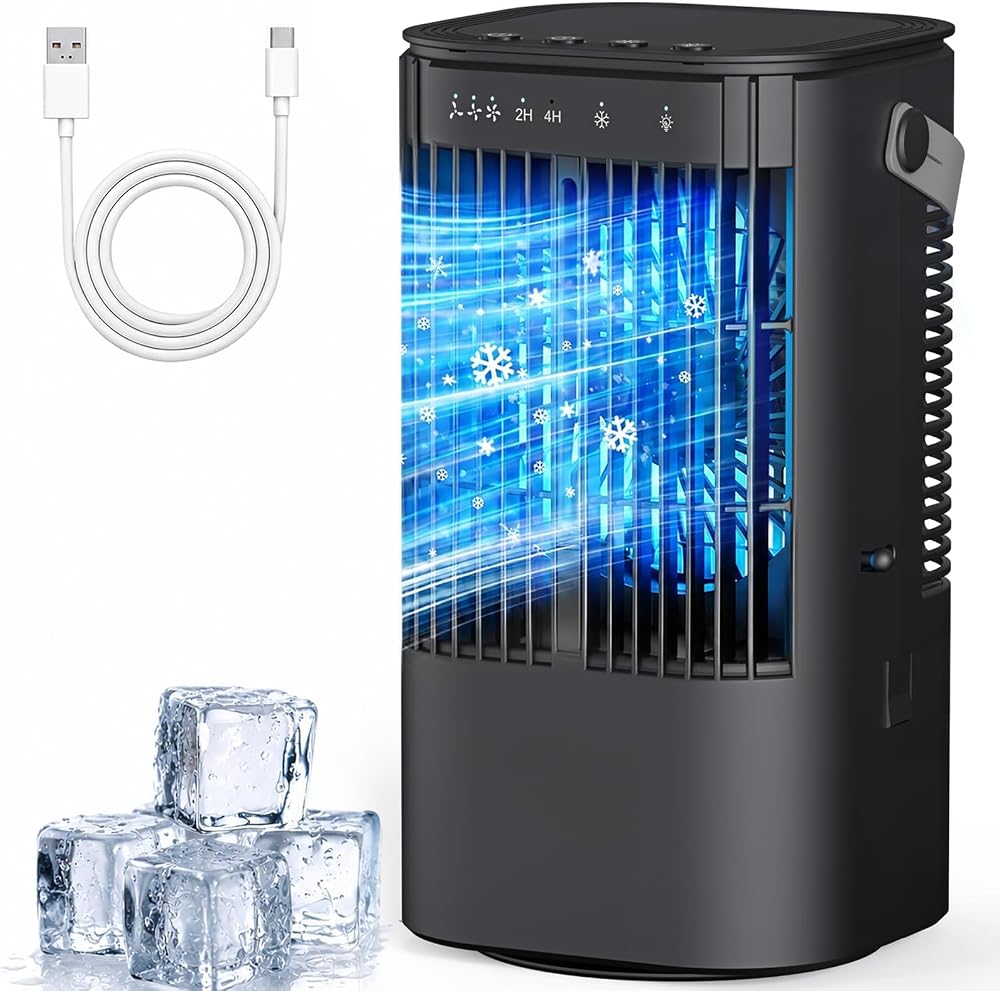
4-in-1 Mini Air Conditioner Evaporative Air Cooler, 1000ML Tank
Four modes, three speeds, a timer and 7-color LED at the lowest cost of the four
Smallest tank of the group, so it needs refilling sooner, and it cannot lower room temperature
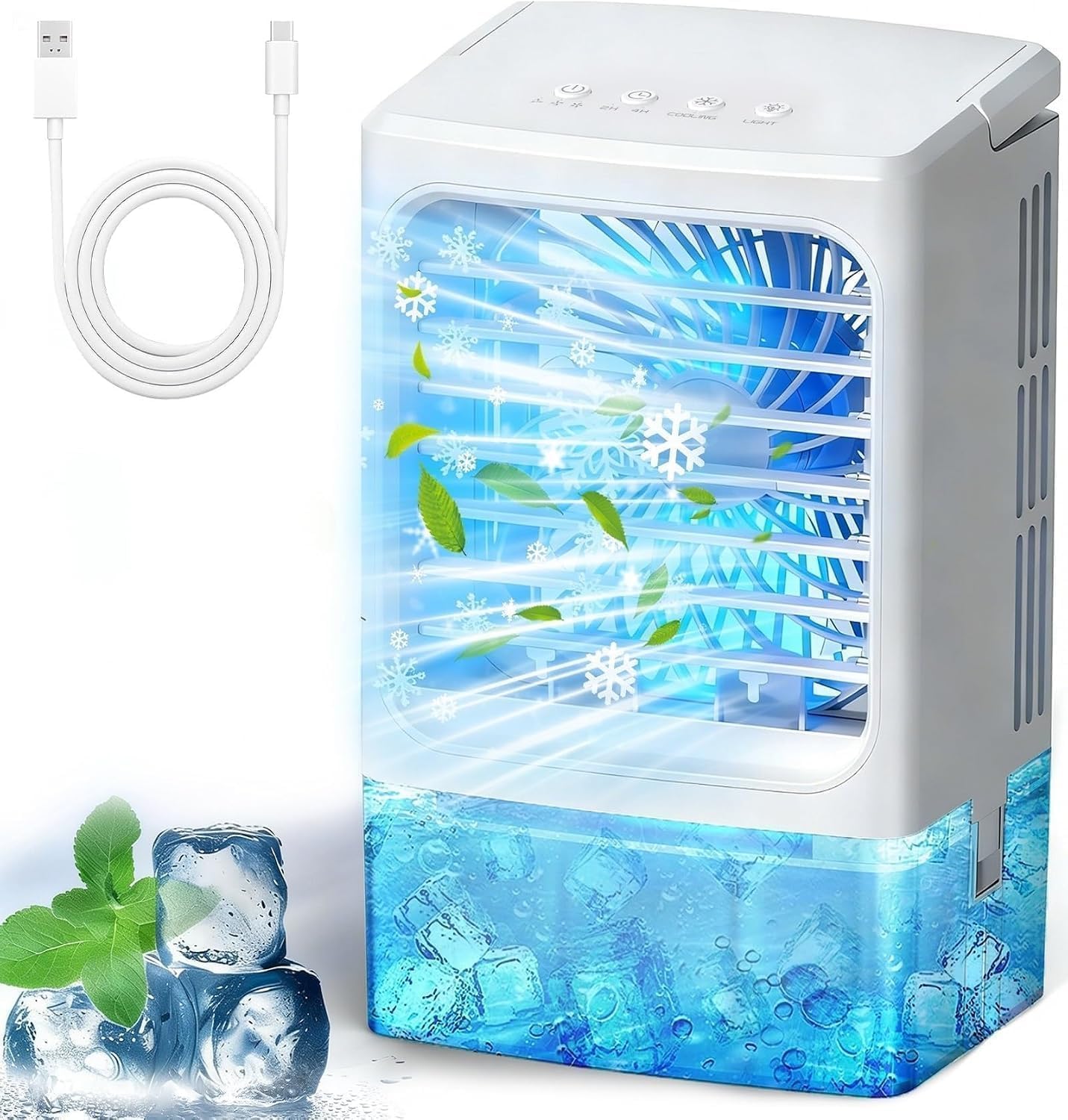
Mini Air Conditioner Small Portable AC Unit, 1500ml spray per hour
Highest listed mist output of the three minis, with cool mist, three speeds and 7-color LED
Misting output is not cooling capacity, and it raises humidity in a closed room
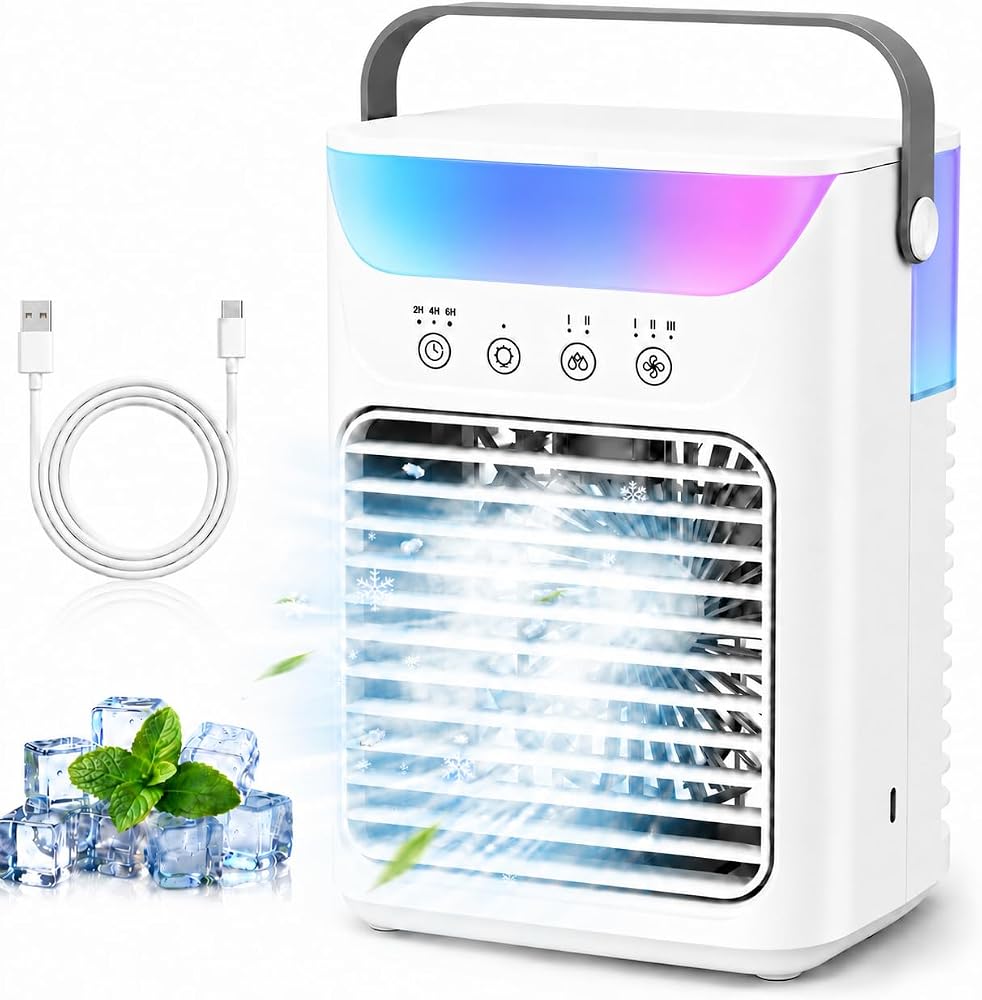
Portable Air Conditioner Desktop AC Cooling Fan, 1500ml, 8 Color Lights
A 2-6H timer, eight light colors and a desktop footprint that also suits a car
Smallest airflow of the group by design, and the light show does nothing for temperature
Prices and availability were captured from Amazon Creators API and may change.
What these four products actually are
Strip the marketing off the box and you have two completely different machines. The 14,000 BTU Smart WiFi Portable Air Conditioner is a refrigeration appliance. It has a compressor, refrigerant, an evaporator coil and a condenser coil, and it moves heat out of your room through an exhaust hose. It also dehumidifies as a side effect, which is why every compressor AC has some kind of water story.
The other three are evaporative coolers. They pull room air across a wet wick or spray a fine mist, and the air that comes out is cooler than the air that went in because evaporation absorbs heat. There is no compressor, no refrigerant, no condenser, and no heat leaving the room through a hose. What leaves is water vapor.
That distinction matters more in some zip codes than others. Evaporative cooling depends on how dry your air is. In Phoenix in June, with single-digit humidity, the wet-bulb spread is enormous and a swamp cooler can genuinely drop the air temperature a lot. In a humid climate, the air is already close to saturated, so almost nothing evaporates, you get a weak breeze and a stickier room. If you live somewhere with summer dew points above 60, an evaporative cooler is a comfort toy, not a cooling strategy.
The one compressor unit here
The 14,000 BTU Smart WiFi Portable Air Conditioner is the only product in this group I would call an air conditioner without air quotes. The listing claims it cools up to 700 square feet, and it lists auto-evaporation, 3-in-1 modes, voice and remote control, and quiet operation.
Take the 700 square feet with a grain of salt. That is a marketing figure, not a tested one. The number that matters for a portable is the SACC rating, the DOE standard that has been in force since 2020 and cut the old marketing BTUs roughly in half for most of these machines. When you look at this unit, find the SACC number, not the sticker on the front. My working rule for a single-hose portable is that real-world coverage runs well under the box claim, and for a room under 300 square feet a window unit will still beat it on efficiency and noise.
Auto-evaporation is the feature I would actually pay attention to here. Portable ACs pull pints of water out of the air every day, and the cheap ones dump that water into a tray you have to empty. Auto-evaporation routes the condensate back over the condenser coil and blows it out the exhaust, so in normal humidity you are not carrying a bucket to the sink twice a day. That is the difference between an appliance and a chore.
The 3-in-1 modes almost always means cool, fan and dehumidify, which makes this unit useful in shoulder season when you want the moisture pulled out but not the compressor running full time. WiFi plus voice control means you can start it before you get home, which beats a remote that needs line of sight to the unit. That last point is a personal grudge of mine, and it is the reason I rank app control above a handset every time.
What the listing does not tell you is the hose configuration, and that is the first question I would ask before buying. One hose or two changes how hard the machine has to work, because a single-hose portable pulls the air it exhausts from inside your house, which means it pulls replacement air in through every gap in the envelope. If you can find a dual-hose version of the same capacity, take it.
The three mini evaporative coolers
These three live in the same category and differ mostly in tank size, mist output, and how many light colors they cycle through.
The 4-in-1 Mini Air Conditioner Evaporative Air Cooler carries a 1000ML tank with three speeds, seven LED colors and a timer. Four modes usually breaks down to something like normal, natural, sleep and a misting setting. The 1000ML tank is the smallest here, so on a high mist setting you will be refilling it more often than the other two. As a desk unit pointed at your face, that is fine. As a bedroom appliance, expect to top it up before you go to sleep.
The Mini Air Conditioner Small Portable AC Unit lists 1500ml of spray per hour, three wind speeds, seven colors, cool mist and a timer. Spray volume is not the same thing as cooling capacity, and it is worth saying plainly: more mist per hour means more water in the air, which is exactly what you want in dry heat and exactly what you do not want in a sealed humid room. Crack a window if you run this one for hours.
The Portable Air Conditioner Desktop AC Cooling Fan lists a 1500ml tank, eight color lights, three wind speeds and a 2-6H timer, and it is the one aimed at car use as well as a desk. This is the most honest name of the three, because it calls itself a cooling fan. It is a fan with a water tank and a light ring. Used that way, at a desk, on a nightstand, or on a center console in a hot car with a power source, it does what it says.
None of the three will lower the temperature of a closed bedroom by any meaningful amount. They cool the air that passes through them, and that air mixes back into the room within a few feet. Point one at your body and it feels good. Leave one running in a shut room and you have added humidity and noise for no temperature gain.
How I judge a cooler before I recommend it
Four questions, in this order. What is the SACC rating, not the marketing BTU? Is it single hose or dual hose? How does it handle condensate? And would I sleep in the room with it running?
Only the first product in this comparison can answer the first three. The minis answer the fourth one reasonably well because they are small fans with a pump, and small fans are quiet.
If you are shopping the compressor category generally, the ranking I give customers has not changed in years. For a room under 300 square feet, a window unit beats any portable. If a window will not work, a dual-hose portable is the next best thing, and a single-hose unit above 10,000 BTU is fighting itself. Capacity claims above 12,000 BTU on a single hose are the most common lie in this product category.
Condensate and drainage
This is the section most reviews skip, and it is the one that decides whether you still like the machine in September. A compressor AC produces condensate continuously. In a humid house it can be gallons a day. If the unit does not re-evaporate that water, you are emptying a tray on a schedule, and if you forget, the unit shuts off or leaks on your floor.
The 14,000 BTU unit lists auto-evaporation, which is the right answer for most homes. In very humid conditions even auto-evaporation units can hit a point where the tray fills faster than the coil can evaporate it, so there is usually a drain port you can run a hose from to a floor drain or a window. That is the setup I recommend for anyone in a humid climate, and it costs you a length of vinyl tubing.
The three minis do not have condensate at all, because they are not removing moisture from the air. They are adding it. The only "drain" question with them is how often you refill the tank and whether the mist leaves a damp spot on whatever is beneath it.
Noise is a spec, not a vibe
A bedroom air conditioner that sounds like a jet engine is a failed product regardless of how cold it gets. Compressor units make noise in two places: the compressor itself and the fan moving air through the condenser. Inverter compressors modulate instead of cycling on and off, which removes the worst of the clatter and the power spikes that come with hard starts.
The minis are in a different class. A small fan with a misting pump is close to silent, and that is a real advantage if you are a light sleeper who just wants moving air. That is the honest reason to buy one of the three small units over the big one, and it is a legitimate reason.
Who should buy which
Buy the 14,000 BTU Smart WiFi Portable Air Conditioner if you need a room cooled to a setpoint, you have a window or vent path for the hose, and you want app and voice control plus auto-evaporation so you are not babysitting a water tray.
Buy the 4-in-1 Mini Air Conditioner Evaporative Air Cooler with the 1000ML tank if you want the least expensive entry into personal cooling with the most mode options and a timer, and you are fine refilling a smaller tank.
Buy the Mini Air Conditioner Small Portable AC Unit with 1500ml spray per hour if you live somewhere dry and you want the strongest mist output of the three pointed at your body while you work or sleep.
Buy the Portable Air Conditioner Desktop AC Cooling Fan with the 1500ml tank, eight light colors and 2-6H timer if you want a desk and car unit that is honest about being a fan, with a timer that turns it off after you fall asleep.
The trade-offs I will not hide from you
The big unit costs many times what the minis cost, needs a window, and is heavy enough that you will not move it between rooms casually. It is also the only one that will change the number on a thermostat.
The minis are cheap, quiet, portable, and powerless against actual heat load. They add humidity, they need refilling, and in a humid climate they are close to useless for anything but moving air across your skin. The 7-color and 8-color light rings are decorative, and I would not let a lighting feature influence a cooling purchase.
One more thing worth saying to anyone in a rental with a dead central system and a landlord who is slow to answer: a portable AC is a stopgap, not a fix. It will hold one room. Close the doors, seal the gaps, and run it where you sleep. That is how you get through a heat wave without a compressor unit the size of a filing cabinet.
Bottom line: one of these four products is an air conditioner, and three of them are personal coolers with water tanks. Buy the 14,000 BTU Smart WiFi Portable Air Conditioner for a room you need actually cooled, and pick one of the three minis for your face, your desk, or your car.