Triple-digit heat does not care about your floor plan. I have spent 18 years as an HVAC technician, most of it in Phoenix, and the calls I get every July follow the same script: the central system quit, the landlord is not coming this week, and the bedroom is unusable by four in the afternoon. That is the moment people start shopping for portable ACs for small rooms, and it is also the moment the marketing gets them. The box says 12,000 BTU. The box is not exactly lying, but it is not telling you what you think it is telling you.
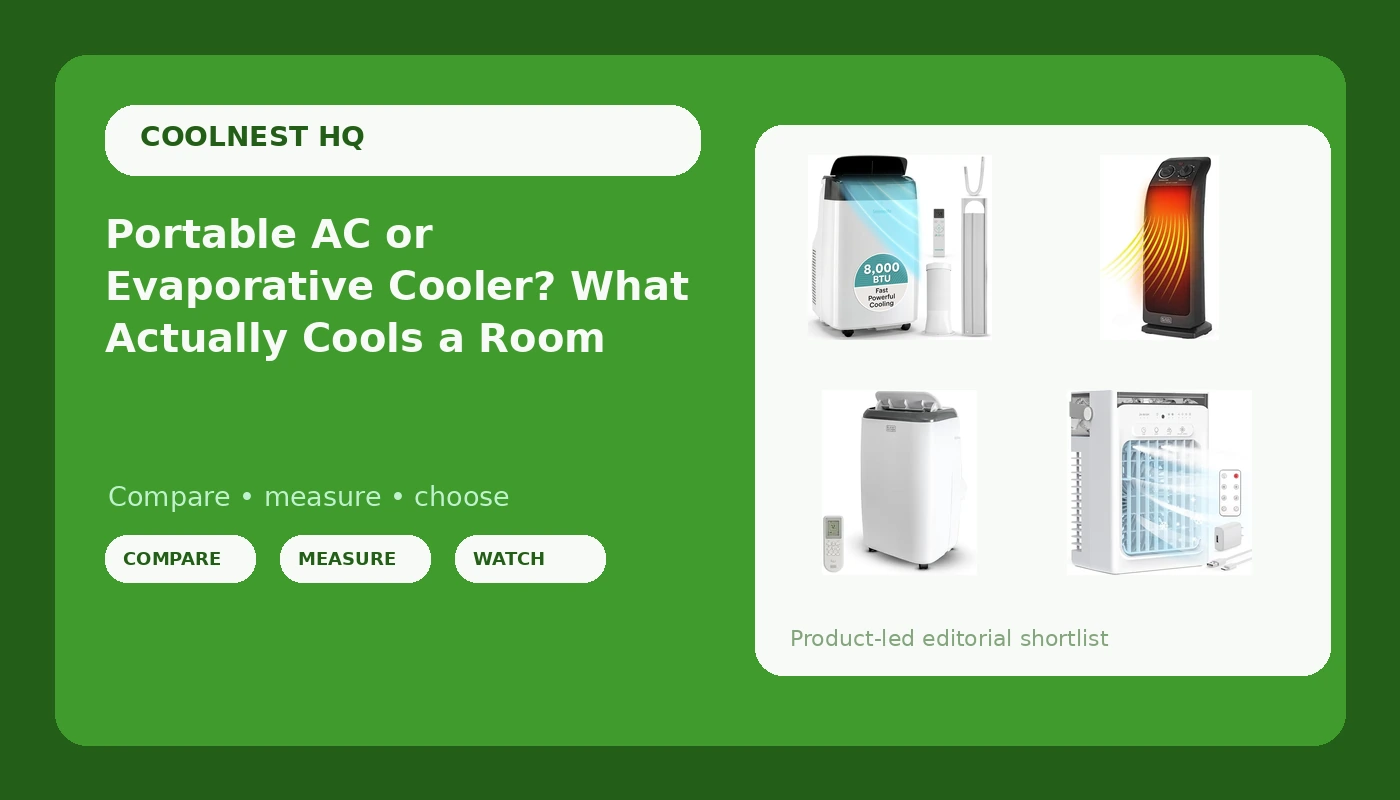
This explainer covers four machines that get lumped together under the portable cooling label: two compressor-based portable air conditioners, one personal evaporative cooler, and one tower heater for the months when the problem reverses. It also covers the numbers and the plumbing questions that decide whether any of them will do the job in your room.
Related: How to Size a Portable AC for a Bedroom →
Quick answer
For a closed room in a hot, humid climate, you want a compressor-based portable air conditioner with a window exhaust path, not an evaporative cooler. Of the units here, the BLACK+DECKER 7,500 BTU model is the smaller compressor option, and the SereneLife 8,000 BTU model is the larger one, listing a dual motor design, dehumidifier and fan modes, a 64°F to 90°F range, three fan speeds, a remote control, and a window exhaust kit. The personal mini cooler is an evaporative device for spot airflow at a desk, a nightstand, a car, or a tent, and it will not cool a room. The BLACK+DECKER tower heater covers the winter half of the same problem.
Four useful options
| Model | Best fit | What stands out |
|---|---|---|
| BLACK+DECKER Portable Air Conditioner, 7,500 BTU (BPT05WTB) | A single small bedroom or office | Compressor-based portable AC, 7,500 BTU rating, white cabinet |
| SereneLife Portable Air Conditioner, 8,000 BTU | A larger or damper single room | Dual motor design, dehumidifier and fan modes, 64°F to 90°F range, three fan speeds, remote control, window exhaust kit |
| Personal Mini Evaporative Air Cooler | Desk, nightstand, car, tent | Three wind speeds, 2/4/8 hour timer, three modes, colorful night light |
| BLACK+DECKER Oscillating Ceramic Tower Heater (BHTC571) | The same room in winter | 1,500 watts, oscillating ceramic tower, black |
Small-room compressor unit: BLACK+DECKER Portable Air Conditioner, 7,500 BTU, BPT05WTB, White
Here is the thing about a 7,500 BTU portable. The number on the box is a marketing figure, and the number that matters is the SACC rating, the Department of Energy standard that describes how much cooling a portable actually delivers once hose losses are counted. SACC figures on portables commonly land well below the headline number, so do not mentally map a 7,500 BTU portable onto a 7,500 BTU window unit. They are not the same machine and they do not cool the same amount of space.
What this unit offers is the simplest shape of the category: one compressor, one room, one exhaust path out a window. If the bedroom door stays closed and the window can take an exhaust panel, this is the right kind of product. If the room opens onto the rest of the house, no portable in this group will keep up with that.
Larger-room compressor option: SereneLife Portable Air Conditioner, With Dual Motor, Dehumidifier & Fan | 8,000 BTU AC With Temperature Ranges 64°F, 90°F | Fast Powerful Cooling | 3 Fan Speeds, Remote Control, & Window Exhaust Kit
This one lists the most detail of any unit in the group: 8,000 BTU, a dual motor design, dehumidifier and fan modes, a 64°F to 90°F range, three fan speeds, a remote, and a window exhaust kit in the box. That last item matters more than people expect. A missing window kit means a second shopping trip and a gap around the exhaust panel that leaks hot outside air straight back into the room you are trying to cool.
The dehumidifier mode is the other detail worth understanding. A portable air conditioner pulls moisture out of the air as it cools, and that moisture becomes condensate. Some units evaporate it back out through the exhaust, some collect it in a tank, and some do both depending on humidity. If a tank fills every four hours, you have bought a job, not an appliance. Read how the listing describes drainage before you commit.
Personal spot cooler: Portable Air Conditioners, Air Cooler Evaporative Personal Mini AC, 3 Wind Speed, 2-4-8H Timer, 3 Modes, Colorful Night Light, Portable AC for Room, Car, Bedroom, Camping d
Evaporative cooling is a real technology, and in a dry climate it is a good one. A fan pulls air across a wet pad, the water evaporates, and the air leaving the unit is cooler than the air entering it. In Phoenix, where June humidity can sit in the single digits, that is not a gimmick. In a humid climate in August, the same machine adds moisture to air that already has too much, and you feel worse rather than better.
The catch is scale. This is a personal cooler, not a room air conditioner. It has three wind speeds, three modes, a 2, 4, or 8 hour timer, and a night light, and it is built to sit on a desk, a nightstand, or a car seat and blow cooler air at a person. It will not drop the temperature of a closed bedroom, and it should not be compared to the compressor units above. If you want airflow pointed at your face while you work, this is the category. If you want the room at 72, it is not.
Cold-season counterpart: BLACK+DECKER Oscillating Ceramic Tower Heater, 1500 Watts, BHTC571, Black
Most of the country does not have Phoenix weather, which means the room that bakes in July freezes in January. A ceramic tower heater is the mirror image of a portable AC: fan-forced heat instead of fan-forced cooling, and a 1,500 watt element that draws close to the maximum a standard 15 amp household circuit will carry. That is why almost every portable space heater tops out at 1,500 watts, and why you should not run one on a light extension cord or a power strip shared with other loads. It belongs in a portable cooling article for a simple reason: it is the same room, the same outlet, and the same question about whether a portable device can condition a space.
Prices and availability may change. Product images, names, and retailer links are matched to verified listings. No current price, rating, stock status, or measured result is stated here without current evidence.
What a SACC rating tells you that the box does not
Before 2020, portable air conditioner BTU numbers were close to meaningless. Manufacturers measured them in ways that flattered the product, and a unit advertised at 12,000 BTU could deliver far less cooling in an actual room. The Department of Energy changed that with the SACC standard, which measures a portable as it is actually used, exhaust hose attached and losses included. The result is that many portables now carry a SACC figure roughly half of what the old sticker claimed.
That is the first number to look for. If a listing leads with a big BTU figure and never mentions SACC, treat the big number as a suggestion. When you compare two portables, compare SACC to SACC. When you compare a portable to a window unit, remember that they are measured differently and that a window unit of the same nominal size will generally outperform the portable because it does not fight its own exhaust.
There is also a climate dimension. A portable's job is to remove heat and moisture from a room, and in a humid climate that moisture load is a real part of the work. Two units with the same SACC rating will feel different in Miami and in Phoenix, and a dehumidifier mode becomes more than a bonus feature.
Single hose, dual hose, and where the condensate goes
A single-hose portable pulls air from the room, uses it to cool the condenser, and dumps it outside. That air has to be replaced, so outside air gets pulled in through every gap in the room, which is the opposite of what you want. A dual-hose design pulls outside air in through one hose and pushes it out through the other, so the room air stays where it is. In my experience, dual hose is the design that stops a portable from defeating itself, and it is the first thing I look for after the SACC rating.
Condensate handling is the second thing. There are three common approaches: a tank you empty, a gravity drain you run to a floor drain or window, and a self-evaporating design that sends moisture out with the exhaust air. In dry heat, a self-evaporating unit can go a long time without attention. In humid heat, expect to deal with water, and pick the method you will actually maintain.
- Measure the room, note the ceiling height, and decide whether the door will stay closed.
- Find the SACC rating in the listing or on the DOE label rather than trusting the headline BTU.
- Identify the hose configuration from the listing photos: one port or two.
- Read the drain description and choose between a tank, a gravity drain, or self-evaporation.
- Confirm the window kit matches your window type, and buy from a seller with a return policy if the unit will run while you sleep.
Practical notes before you buy
- A window unit beats any portable for a closed room under roughly 300 square feet if your window can take one. Portables are for when it cannot.
- Seal the exhaust panel with foam or weatherstrip. A loose panel undoes a surprising amount of the cooling you paid for.
- Keep the unit out of direct sun and give the exhaust hose the shortest, straightest run you can manage.
- Never plug a 1,500 watt heater into a light extension cord, and never share that circuit with a portable AC.
- Check the condensate situation during the first week, then build a routine around whatever the unit actually does.
Which option should you choose?
Choose the BLACK+DECKER Portable Air Conditioner, 7,500 BTU, BPT05WTB, White when you need to cool one small, closed room and you want the simpler compressor unit in this group. Choose the SereneLife Portable Air Conditioner when the room is larger or feels damp and you want dehumidifier and fan modes, a remote, and a window kit included. Choose the personal mini evaporative cooler when you want cooler airflow on a person in a dry climate, at a desk, in a car, or in a tent, and you are not trying to condition a room. Choose the BLACK+DECKER Oscillating Ceramic Tower Heater when the same room turns cold and you need spot heat instead of cooling.
Two things a product name cannot tell you: how loud a unit actually runs, and how much cooling it delivers once hose losses are counted. Those are the two figures I care about most, and they are the two that listings state least clearly. Treat the noise spec and the SACC rating as things to verify before you buy.
The bottom line
Portable cooling is a compromise category, and the compromise is easiest to live with when you match the machine to the job. If you need a closed room cooled in a hot, humid climate, buy a compressor-based portable air conditioner, plan the exhaust path, and check how it handles condensate. If you need air moving across you in a dry climate, an evaporative cooler does that with far less power and far less noise. If the room swings from unbearable to cold across the year, a tower heater is the other half of the same purchase. What I would not do is buy a single-hose unit rated far above the room and expect the sticker on the box to be honest. It rarely is.