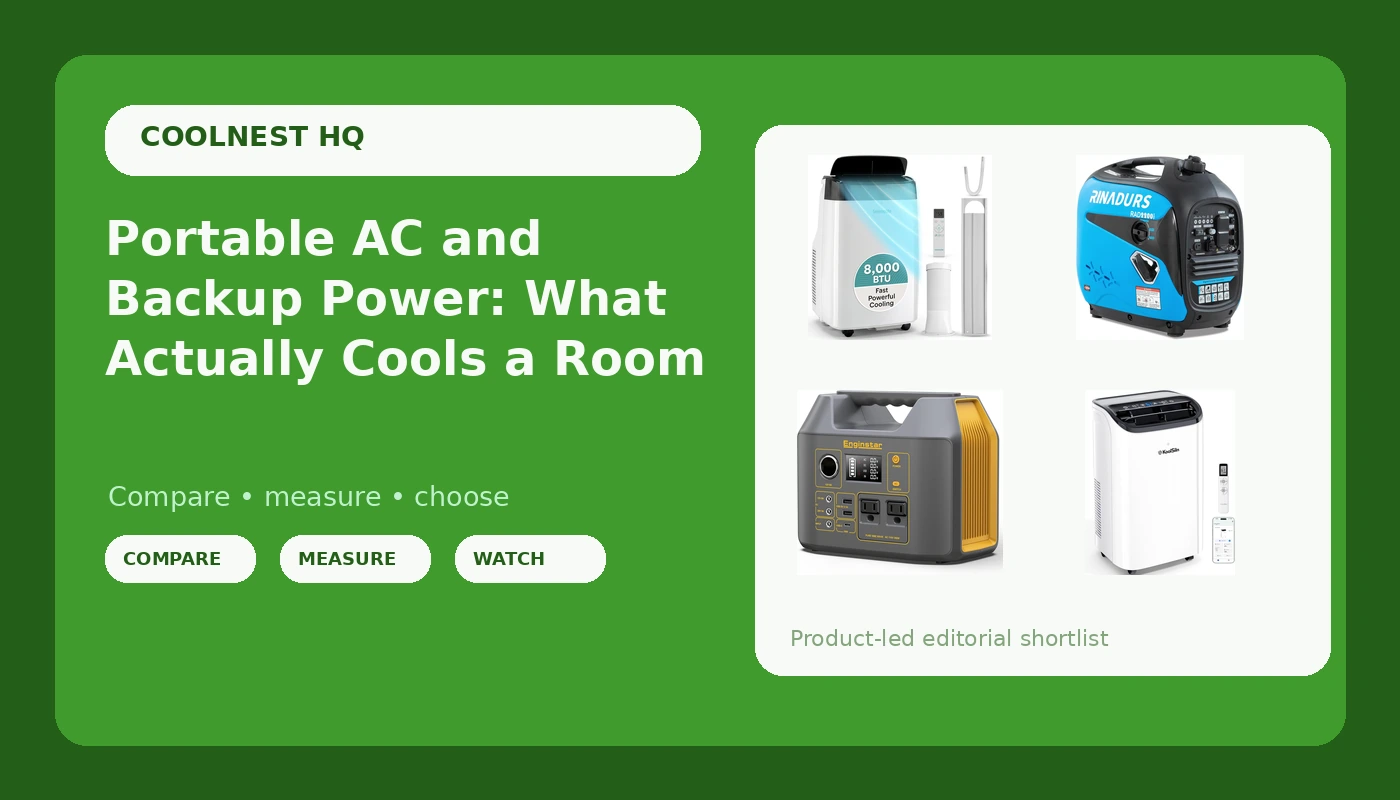
Portable AC and backup power is the pairing that decides whether a hot room stays livable when the window does not cooperate and the outlet is not reliable. Three problems show up in almost every shopping cart in this category: the BTU number on the box does not match the room, the exhaust setup fights itself, and the condensate bucket fills faster than anyone planned for. The four options below cover different parts of that problem. Two are portable air conditioners built for different room sizes, and two are power sources for when the AC has nowhere to plug in. Matching the equipment to the room, rather than to the marketing copy, is the entire job.
Related: Portable AC Sizing: BTU Ratings and Room Square Footage →
Quick answer
A portable air conditioner has to be matched to room size and window access first, and the power source has to be matched to the air conditioner second. For a large room, office, or garage, the 14,000 BTU WiFi unit is the option with the capacity for that job. For a smaller bedroom, or a room where humidity is half the problem, the SereneLife 8,000 BTU unit adds dehumidifier and fan modes. When there is no outlet where the AC needs to run, the RINADURS 2200W inverter generator covers fuel-powered backup and the EnginStar 296Wh power station covers smaller, quieter loads. No single unit here is the right answer for every room, because the correct choice changes with square footage, window access, and whether the power has to come from a battery or a fuel tank.
Four useful options
| Model | Best fit | What stands out |
|---|---|---|
| 14,000 BTU Portable Air Conditioner with WiFi & Remote Control, Cools Up to 700 Sq.Ft, Auto-Evaporation Low Noise Portable AC Unit for Large Room, Office, Garage, White | Large rooms, offices, and garages up to the listed 700 sq ft | Listed 14,000 BTU capacity, WiFi and remote control, auto-evaporation for condensate |
| SereneLife Portable Air Conditioner, With Dual Motor, Dehumidifier & Fan, 8,000 BTU AC With Temperature Ranges 64°F, 90°F | Smaller rooms that also need humidity control | Listed 8,000 BTU capacity, dehumidifier and fan modes, 3 fan speeds, window exhaust kit included |
| 2200W Portable Inverter Generator, Fuel Efficient Gas Powered Generator with CO Sensor, Parallel Ready, Lightweight Power for Camping, Tailgating, Outdoor Use and Emergency Backup by RINADURS | Running an AC or appliances where no outlet exists | 2200W inverter output, CO sensor, parallel-ready design, gas powered |
| EnginStar 296Wh Portable Solar Generator, Pure Sine Wave Power Station | Small loads and short runtimes, recharged from a wall outlet or panels | 296Wh capacity, pure sine wave output, solar-generator design |
The large-room pick: 14,000 BTU Portable Air Conditioner with WiFi & Remote Control
The 700 sq ft figure is a listing claim, and it assumes a normal ceiling, reasonable insulation, and a room that is not baking in direct afternoon sun. In real heat the practical number is usually smaller, partly because a portable has to reject its heat through a hose, which is less efficient than a window unit or a central system. What makes this one the starting point for a large room is simply that it has the capacity to be in the conversation at all. Auto-evaporation is the feature worth noticing: condensate is what turns a cooling appliance into a chore, and any design that keeps water out of a bucket is doing you a favor. Plan the window access before it arrives, because a unit this size needs somewhere to exhaust and clearance around the intake.
The small-room pick: SereneLife Portable Air Conditioner
The dual motor description covers the fan and the compressor. It does not tell you whether the exhaust is a single hose or a dual hose, and that is the spec worth confirming on the listing, because a single-hose unit pulls already-cooled air out of the room to cool the condenser and then replaces it with hot outdoor air through every gap it can find. The dehumidifier mode matters more than people expect in humid regions, where a unit that only chills air leaves the room feeling clammy. The included window kit is a real convenience, since kits are the part people forget to buy. Keep the unit near the window, keep the hose short, and treat the top of the temperature range as a thermostat setting rather than a promise about what the room will reach.
The fuel backup: RINADURS 2200W Portable Inverter Generator
Inverter output matters for electronics, and the CO sensor is the safety feature you want on anything burning fuel near a structure. Parallel-ready is the honest way to grow into a bigger load later instead of buying a second, larger machine. The catch with air conditioning is startup surge: a compressor pulls a hard spike of current the moment it kicks on, so the generator's running watts are not the whole story. Read the nameplate watts on the AC you plan to run and leave headroom above it. Generators also have to run outdoors, away from windows and doors, which means a cord run and some thought about weather. That distance is a feature, not an inconvenience.
The battery backup: EnginStar 296Wh Portable Solar Generator
296Wh is a small battery, and it should be described that way. It is enough for a fan, a router, a laptop, lights, and phone charging for a stretch of hours, and it can sit inside a house without exhaust concerns. It is not a realistic way to run a large portable air conditioner for hours: a compressor in that class draws a heavy load, and a battery this size would be spent quickly. The honest role for this unit in a heat wave is keeping a room usable overnight when the grid fails, running a fan and charging devices, with panels as a recharge path if the outage runs long. Pure sine wave output is the spec that matters most here, because it is what protects the electronics you plug into it.
Prices and availability may change. Product images, names, and retailer links are matched to verified listings. No current price, rating, stock status, or measured result is stated here without current evidence.
Why the BTU number on the box is not the number that matters
Portable air conditioners were sold with inflated BTU figures for years, and the DOE's 2020 test standard was meant to correct that. Many listings still lead with the older, marketing-friendly number, while the SACC rating is the one measured under conditions that resemble an actual room. In practice, a portable advertised at 12,000 BTU can carry a SACC rating much closer to half that. That is not a knock on a specific brand. It is how the category works, and it is the reason sizing a portable is a different exercise from sizing a window unit. When you compare options, look for the SACC number on the listing or the energy label, then hold it against the square footage you actually need to cool rather than the square footage in the headline.
The second buried spec is hose design. A single-hose portable pulls air from inside the room, uses it to cool the condenser, and pushes it outside. That air has to be replaced from somewhere, and it comes back in as hot outdoor air through gaps and doorways, which is the unit partly undoing its own work. A dual-hose design uses one hose to bring in outside air for the condenser and one to exhaust it, and it avoids that penalty. A third consideration is condensate: how a unit removes the water it pulls from the air decides whether you own an appliance or a twice-a-day chore.
How to size a portable AC and its power source
Work through these in order, because each one changes the answer to the next.
- Measure the room, not the house. Note square footage, ceiling height, and how much direct sun hits the windows. A west-facing room with a large window is a harder job than the same square footage facing north.
- Find the SACC rating before you trust the headline BTU figure. If the listing shows only one number, treat the sizing as approximate and buy a little more capacity than the room math suggests.
- Confirm the window situation and the hose type. A vertical slider, a crank-out casement, or a sealed picture window each need a different kit, and dual hose is worth paying for where it is available.
- Decide how the water leaves. Auto-evaporation, a drain hose to a floor drain, or a bucket all mean different routines. Bucket duty in a humid climate is a real commitment.
- Size the power source to the AC's actual draw. Read the nameplate watts, add headroom for compressor startup, and match it against the generator's running watts or the power station's capacity.
Living with a portable AC in real heat
- Put the unit as close to the window as the setup allows, and keep the exhaust hose short, straight, and free of kinks.
- Seal the window kit. A loose panel turns the exhaust into a loop that pulls its own heat back in.
- Give the intake and the exhaust real clearance. Pushing a unit flush against a curtain or a wall chokes it.
- Watch the condensate on humid days, and use a drain hose to a floor drain if the unit supports one.
- Decide your noise tolerance before you buy, especially for a bedroom. Compressor cycling is the sound you will live with.
- Avoid long, thin extension cords. If a run is unavoidable, use a heavy-gauge cord rated for the load.
Which option should you choose?
Choose the 14,000 BTU Portable Air Conditioner with WiFi & Remote Control when the room is large, the window can take the exhaust, and you want the capacity headroom to cool an open space. Choose the SereneLife Portable Air Conditioner when the room is bedroom-sized or smaller and humidity is part of what makes it uncomfortable. Choose the RINADURS 2200W Portable Inverter Generator when the space has no working outlet, or when a heat wave knocks the power out and you need to run a compressor off fuel. Choose the EnginStar 296Wh Portable Solar Generator when you need quiet, indoor, fume-free power for small loads and short runtimes, with panels as a recharge option.
One caveat that applies to all four: the descriptions above come from the listings themselves, and the numbers in them are the manufacturer's. Confirm the SACC rating, the hose configuration, the nameplate wattage, and the window kit requirements on the product page before you commit, because those details decide whether the unit fits your room and your routine.
The bottom line
Cooling a hot room is two purchases, not one: the air conditioner and the way you power it. Match the AC to the square footage using the SACC rating rather than the headline BTU number, confirm the hose design and the condensate plan, and then match the power source to the compressor's real draw. The 14,000 BTU unit is the one built for large spaces, the SereneLife is the bedroom-sized option with humidity control built in, the RINADURS generator is the answer when there is no outlet, and the EnginStar power station is the quiet indoor option for small loads. Get those matches right and the equipment disappears into the background, which is exactly what you want from it.