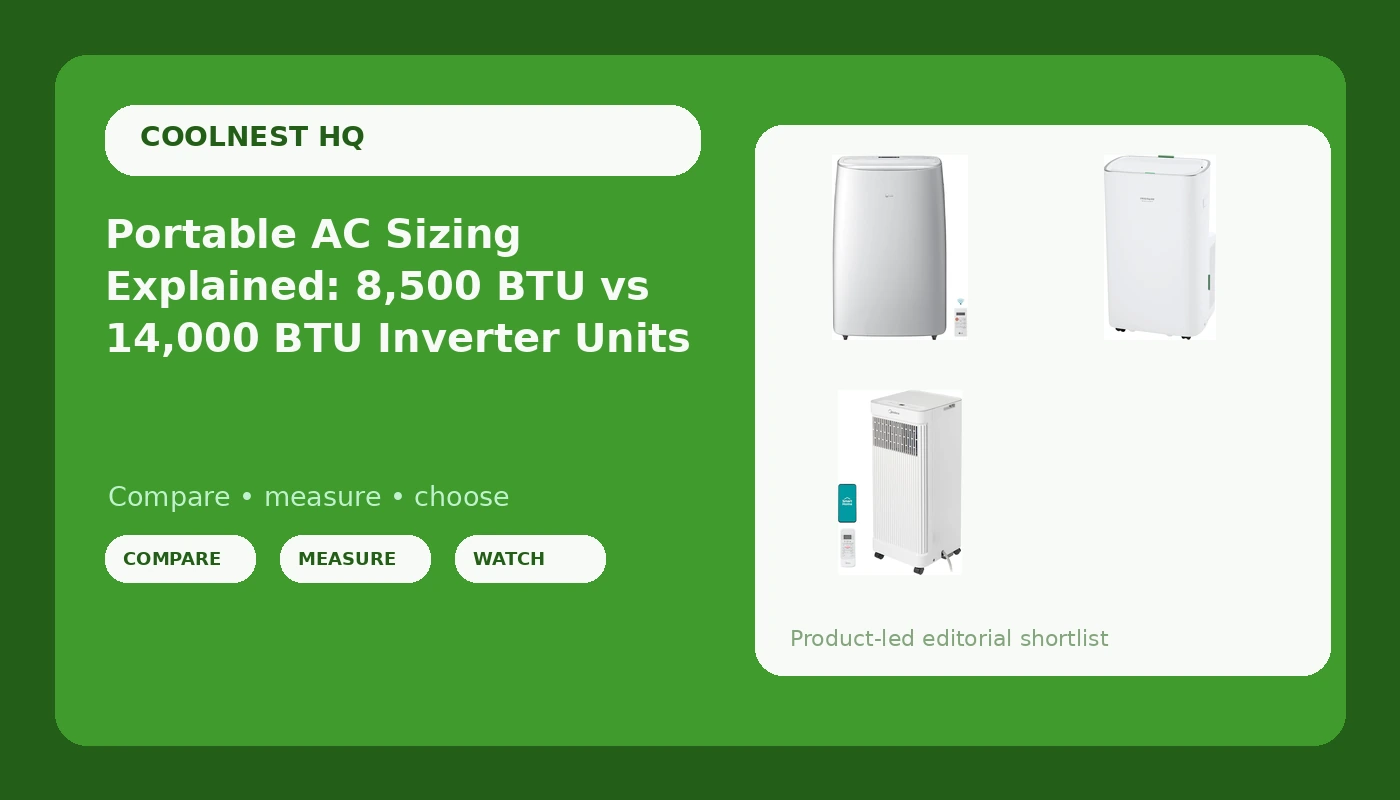
Portable air conditioners are the appliance category where the packaging lies the loudest. A sticker that reads 12,000 BTU can describe a machine that never gets comfortable in a 200 square foot bedroom, because that headline number is an ASHRAE rating produced under test conditions that rarely match a real room in August. The inverter portable air conditioner class is where the category has quietly improved: a variable-speed compressor that modulates instead of slamming on and off runs steadier, starts softer, and generally draws less power across a long cooling season. What has not gotten simpler is matching the machine to the room and to the way you will actually live with it, including where the condensate goes and whether you can sleep through the compressor. Three current models bracket the range: an 8,500 BTU unit built for small spaces, a 14,000 BTU dual inverter model, and a 14,000 BTU inverter unit that also provides heat.
Related: SACC vs ASHRAE BTU: How to Read a Portable AC Label →
Quick answer
Match the unit to the room first, then to the compressor, then to the extras. For a room of roughly 150 square feet, the Midea 8,500 BTU ASHRAE portable is the sized-right choice, since the manufacturer rates it for coverage up to 150 sq ft. For larger rooms, a 14,000 BTU class inverter model is the better starting point: the LG DUAL Inverter LP1419IVSM for cooling only, and the Frigidaire Gallery 14,000 BTU inverter unit if you also want heat for cooler months. The one number worth chasing down before you buy is the SACC rating, not the ASHRAE figure that usually appears first in a listing title.
Three useful options
| Model | Best fit | What stands out |
|---|---|---|
| Midea 8,500 BTU ASHRAE Portable Air Conditioner, Cools up to 150 Sq. Ft. | Bedrooms, offices, and dorm rooms around 150 sq ft | Manufacturer-stated coverage up to 150 sq ft in a portable, vent-through-window format |
| LG DUAL Inverter 14000 BTU Portable Air Conditioner with Remote Control, White (LP1419IVSM) | Larger rooms where cooling is the only job | 14,000 BTU ASHRAE rating with a dual inverter compressor and an included remote |
| Frigidaire Gallery 14,000 BTU Inverter Portable Air Conditioner, Heat | Rooms that need warming in shoulder seasons too | 14,000 BTU class cooling plus a heat function in one cabinet |
Small rooms: Midea 8,500 BTU ASHRAE Portable Air Conditioner, Cools up to 150 Sq. Ft.
The trade-off with a small-room portable is honest: it is the right tool when the space is genuinely small, and the wrong tool the moment you ask it to carry a hallway, a stairwell, or a room with a west-facing wall of glass. An 8,500 BTU ASHRAE rating also does not translate directly into an 8,500 BTU SACC rating, and the gap matters most precisely in this capacity class, where a few thousand BTU of real-world loss is the difference between a cool bedroom and a noisy fan with a hose attached. Read the listing carefully, compare the SACC figure against the square footage you are actually cooling, and expect to close doors and block the room off. If the space is bigger than the manufacturer's stated coverage, this is the wrong shelf, not a defective product.
Larger rooms, cooling only: LG DUAL Inverter 14000 BTU Portable Air Conditioner with Remote Control, White (LP1419IVSM)
Inverter control is the single most useful feature to understand in this comparison, because it changes two things a spec sheet does not fully convey. A modulating compressor holds the room temperature closer to the set point instead of overshooting and coasting, and it avoids the repeated hard starts that make fixed-speed portables sound like they are clearing their throat every few minutes. That said, capacity class is not a substitute for a SACC check: manufacturers commonly position 14,000 BTU ASHRAE portables toward larger rooms, while the SACC rating for the same machine is typically lower and is the number that predicts performance under real conditions. This unit is cooling only, so if you need a warm room in December, it is not the right pick. Setup realities still apply: the vent hose needs a window, the unit needs clearance around its intake, and a remote only helps if you can see the unit, which is exactly the limitation that sends people walking across the room anyway.
Cooling plus heat: Frigidaire Gallery 14,000 BTU Inverter Portable Air Conditioner, Heat
A heat function is the feature people underestimate and then use constantly, particularly in rentals, additions, converted garages, and any room the central system never handled well. It also changes the economics: a single cabinet that cools in July and warms in November replaces two appliances and the storage space both of them need. The trade-off is that heat mode on a portable draws attention to the same venting problem that cooling mode already has, and it runs during the months when you are least interested in a window being partially open. Ducting quality matters more in heat mode than most buyers expect. If the window kit leaks, you are heating the neighborhood. Buyers who only ever need summer cooling should not pay for the heat function; buyers who have a genuinely cold room should weigh it heavily.
Prices and availability may change. Product images, names, and retailer links must be matched by verified ASIN. Do not state a current price, rating, stock status, or measured result without current evidence.
ASHRAE BTU versus SACC: which number describes your room
Portable air conditioners spent years getting away with the same rating test used for other cooling equipment, and the result was a category full of optimistic labels. The Department of Energy's 2020 standard changed that by requiring portables to carry a Seasonal Adjusted Cooling Capacity figure, usually shortened to SACC, which accounts for the ways a portable loses capacity in a real room rather than on a test bench. SACC ratings typically land well below the older ASHRAE number for the same machine, which is why a unit advertised as 12,000 BTU may perform closer to a smaller figure once it is sitting on your floor with a hose running to a window.
That gap exists because a portable is not a sealed system in the way a window unit or a central air handler is. It has to move heat through a hose, and the design of that hose changes everything. A single-hose portable pulls air from the room it is trying to cool, blows that air across the condenser, and dumps it outside. The air leaving the room has to be replaced, and it gets replaced by hot outdoor air seeping in through every gap in the building envelope. A dual-hose design separates the intake from the exhaust so the condenser gets its own air supply, which is a real advantage, though dual-hose units are bulkier and fussier to set up. Neither design beats physics: a portable is at its best when a window unit genuinely cannot be installed.
Condensate is the third number nobody puts on the box. An air conditioner pulls water out of the air as it cools, and a portable has to put that water somewhere. Some designs evaporate it and throw it out with the exhaust, some collect it in an internal tank that you empty by hand, and some support a gravity drain or a condensate pump. In a humid climate, a small tank with no drain option means frequent emptying, and that single detail decides whether a unit feels like an appliance or a chore. Before buying, find out which system the model uses.
Inverter compressors, fixed-speed compressors, and noise at bedtime
A fixed-speed compressor has two settings: full power and off. It cools the room below the set point, shuts down, waits for the temperature to drift up, and slams back on. You feel that as temperature swings and hear it as a repeated startup thump. An inverter compressor modulates, running at partial capacity for long stretches, which usually means a steadier room and fewer jarring transitions. The term dual inverter, as LG uses it, refers to inverter control applied to more than one motor in the system, and it is a refinement of the same idea rather than a different technology.
Noise, though, is not settled by the compressor alone. Fan speed, cabinet resonance, the surface the unit sits on, and how well the window kit seals all contribute. The only meaningful test is a bedroom test: run the unit in the room where you sleep and decide whether you can fall asleep with it on. If you cannot, the cooling capacity is irrelevant.
Five steps for choosing between these three models:
- Measure the room in square feet, then write down how many doors and windows it has and which direction the windows face.
- Find the SACC rating in the listing and compare it against your square footage, ignoring the ASHRAE figure in the product title.
- Decide whether you need heat, because that requirement alone eliminates the cooling-only options.
- Check how the unit handles condensate: evaporated, tank, gravity drain, or pump.
- Plan the window and hose route before delivery, including how much of the window stays open and how the sash gets sealed.
Practical guidance before you order
- Measure the room, not the apartment. A portable cools the space it is in, and an open doorway turns a bedroom into a hallway.
- Compare SACC against square footage, and treat any listing that only shows an ASHRAE number as incomplete information.
- Decide up front whether a window unit is possible. In a room under 300 square feet, a window unit generally outperforms any portable of similar capacity.
- Budget for sealing: foam board, weatherstrip, and tape for the window kit, plus a drain hose if the unit supports one.
- Think about placement. The vent hose should run as short and as straight as the window allows, and the unit needs clearance around the intake.
- If noise is your deciding factor, buy from a seller with a return policy you are comfortable using.
Which option should you choose?
Choose the Midea 8,500 BTU ASHRAE Portable Air Conditioner, Cools up to 150 Sq. Ft. when the room is small and matches the manufacturer's stated coverage, and you want the simplest, least expensive way to cool one bedroom, office, or dorm room. Choose the LG DUAL Inverter 14000 BTU Portable Air Conditioner with Remote Control, White (LP1419IVSM) when the room is larger, cooling is the only job, and you want inverter modulation plus a remote in the box. Choose the Frigidaire Gallery 14,000 BTU Inverter Portable Air Conditioner, Heat when the same room also gets cold in the shoulder seasons and you would rather run one cabinet year round than store two appliances.
None of these distinctions rest on measured performance in your home, and none of the ratings quoted here are independent test results. They come from manufacturer specifications, which is exactly why the SACC figure and the condensate design deserve more of your attention than the BTU sticker. Verify current specifications and coverage claims on the listing before you commit, and confirm the return window in case the unit cannot keep up with your room.
The bottom line
Portable AC shopping comes down to three questions: how big is the room, does it need heat, and who empties the water. An 8,500 BTU unit like the Midea is the right answer for a small room and the wrong answer for an open living space. A 14,000 BTU class inverter model is the better fit once the room grows, and the choice between the LG dual inverter and the Frigidaire Gallery unit really comes down to whether you want heating capability in the same cabinet. Check the SACC rating rather than the headline BTU, confirm how condensate is handled, and decide honestly whether a window unit could work instead, because in a small room it usually wins.