Most people shopping for a portable AC for small rooms are solving a problem that is only half about cooling. A bedroom that will not drop below 80 degrees. A rental whose windows will not take a window unit. A garage office that bakes by noon. A heat wave that outlasts the grid. Each of those situations points at different hardware, and buying the wrong piece is how a household ends up with a fan that has a hose, a bucket to empty, and a receipt they regret.
This explainer covers four products that compete for that same search: a ducted portable air conditioner, an evaporative desk cooler, a portable power station, and a ceramic tower heater. Each one does a real job. None of them does all of the jobs, and the overlap in how they are marketed is exactly where buyers get hurt.
Related: Why Portable AC BTU Ratings Are Misleading →
Quick answer
If the goal is to lower the temperature of an enclosed room, a ducted portable air conditioner is the only product in this group that removes heat from the space. An evaporative cooler adds moisture to the air and cools by evaporation, which works in dry climates with airflow and performs poorly in humid rooms. A portable power station does not cool anything on its own; it keeps a fan, a light, or a small appliance running when the wall outlet cannot. A ceramic tower heater covers the cold end of the year.
Four useful options
| Model | Best fit | What stands out |
|---|---|---|
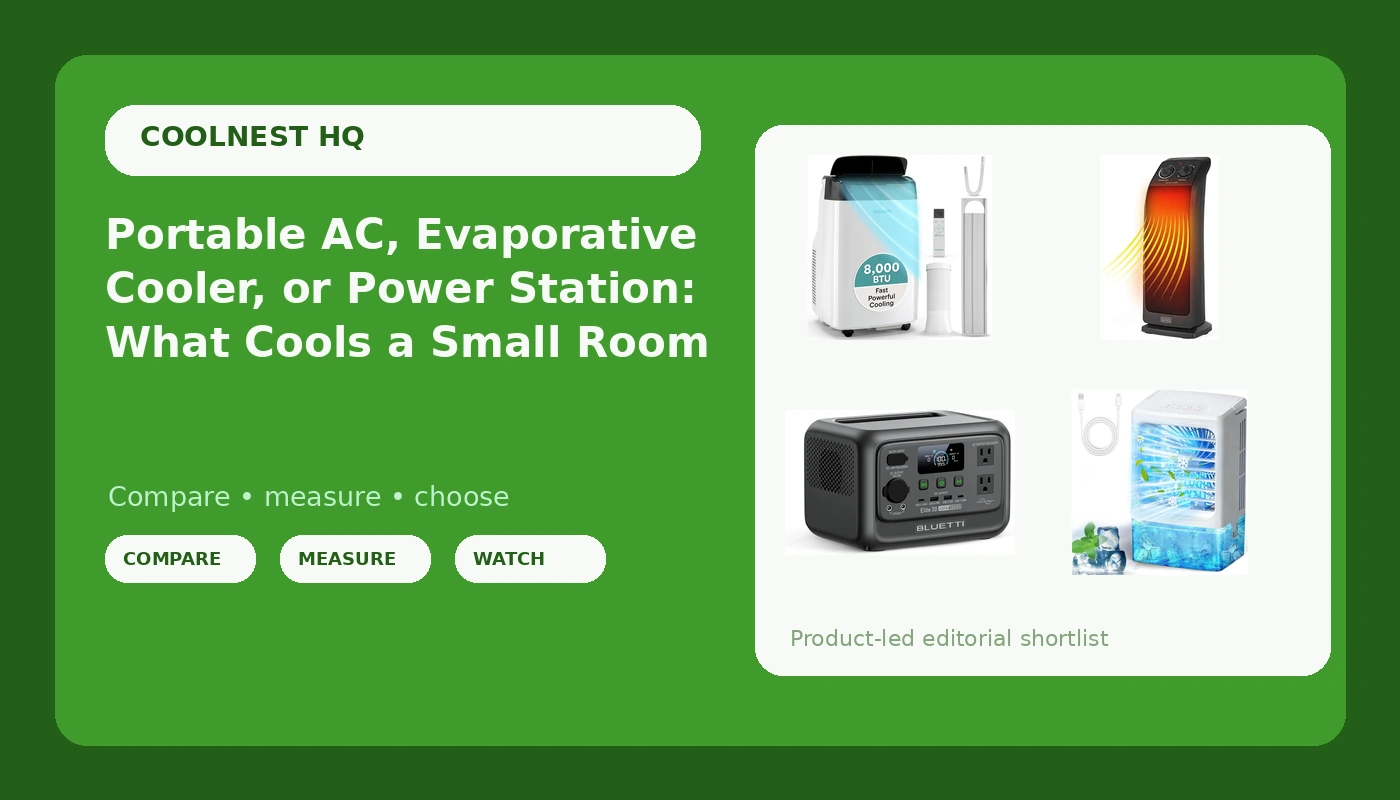
| SereneLife Portable Air Conditioner, With Dual Motor, Dehumidifier & Fan | 8,000 BTU AC With Temperature Ranges 64°F, 90°F | Fast Powerful Cooling | 3 Fan Speeds, Remote Control, & Window Exhaust Kit | A room with a window that can accept an exhaust hose | 8,000 BTU rating, dehumidifier and fan modes, stated 64°F to 90°F range, three fan speeds, remote, window exhaust kit |
| Mini Air Conditioner Small Portable AC Unit Portable Air Conditioners with 1500ml spray/hour 3 Speed Wind & 7 Colorful LED Light Cool Mist &Timer Evaporative Air Cooler for Bedroom/Home/Office | A desk, nightstand, or workbench where you want air on you | Evaporative design, 1,500 ml per hour spray output, three wind speeds, timer, seven-color light |
| BLUETTI Elite 30 V2 Portable Power Station 288Wh 600W LFP Solar Generator | Keeping a fan or small appliance alive during an outage | 288Wh LFP battery, 600W output, solar and wall charging |
| BLACK+DECKER Oscillating Ceramic Tower Heater, 1500 Watts, BHTC571, Black | A room that turns cold at night in winter | 1,500 watts, ceramic element, oscillating tower body |
Room cooling: SereneLife Portable Air Conditioner, With Dual Motor, Dehumidifier & Fan | 8,000 BTU AC With Temperature Ranges 64°F, 90°F | Fast Powerful Cooling | 3 Fan Speeds, Remote Control, & Window Exhaust Kit
The trade-offs are installation and water. A ducted portable has to sit near a window, the exhaust hose has to vent outdoors, and the compressor produces condensate that either collects in a tank you empty or drains through a hose you route. It also takes up floor space and adds compressor noise to the room, which is the price of actual heat removal.
Personal cooling: Mini Air Conditioner Small Portable AC Unit Portable Air Conditioners with 1500ml spray/hour 3 Speed Wind & 7 Colorful LED Light Cool Mist &Timer Evaporative Air Cooler for Bedroom/Home/Office
The catch is physics. Evaporative cooling raises indoor humidity, and humid air is harder to cool and harder to sleep in. In a dry climate with a door or window open for air exchange, that trade can be worth it. In a sealed, muggy room, adding mist just makes the room sticky, and no amount of fan speed changes that.
Backup power: BLUETTI Elite 30 V2 Portable Power Station 288Wh 600W LFP Solar Generator
Runtime is entirely a function of the load, and the honest framing is that this is a fan-and-lights battery. Compressor-driven air conditioners demand far more continuous power than a station in this class is rated to supply, and the surge at compressor startup is higher still. What a battery this size does well is keep a low-wattage fan moving air through a bedroom on the hottest night of a blackout, which is often the difference between sleeping and not.
Cold-weather heating: BLACK+DECKER Oscillating Ceramic Tower Heater, 1500 Watts, BHTC571, Black
The trade-off with any 1,500-watt heater is electrical. That draw sits close to the continuous limit of a standard household branch circuit, so it should have an outlet largely to itself, never a power strip or an extension cord, and never a circuit already carrying a portable air conditioner. Heaters also dry the air, which is the opposite problem from the mist cooler above.
Prices and availability may change. Product images, names, and retailer links are matched to verified listings. No current price, rating, stock status, or measured result is stated here without current evidence.
What a BTU rating actually measures
A BTU is a quantity of heat, and an air conditioner's rating describes how much of it the unit can move per hour under test conditions. That number is not a promise about your room. Door gaps, west-facing glass, attic heat, ceiling height, and the number of people and computers in the space all change the load, and a portable unit that is oversized for a small room will short-cycle and dehumidify poorly.
There is a second number worth understanding. Since the DOE changed how portable air conditioners are rated, the figure on a portable box reflects a more realistic test than the old marketing number did, and it is usually lower. When you compare a portable against a window unit, compare the same type of rating, or you are comparing two different measurements that happen to share a unit name.
A rough starting point for sizing is about 20 BTU of cooling per square foot of floor area, then add for strong sun, kitchen heat, and occupancy. That math is a starting point, not a guarantee, and it is the reason two rooms of identical size can need different equipment.
Why airflow and condensate decide daily ownership
Venting matters as much as capacity. A portable air conditioner has to reject heat somewhere, and it does that through a hose to a window. Designs that use a single hose pull air from the room to cool the condenser and then push that air outside, which drops the pressure in the room and pulls hot replacement air in through every gap. Dual hose designs avoid that exchange by using outdoor air for the condenser side. Either way, the window opening has to be sealed around the hose panel or the unit is fighting the house.
Condensate is the other daily reality. Some units evaporate most of the water they pull from the air, some collect it in a tank, and some are built for a gravity drain hose. A tank you empty twice a day turns a cooling appliance into a chore, so the drain path belongs in the buying decision, not in the surprise category.
Noise follows the same logic. A compressor is a mechanical device with a fan attached, and it will be audible in a bedroom. If silence is the priority, a fan plus a battery is quieter than any compressor, and it costs a lot less cooling.
- Measure the room and count the windows that could take an exhaust hose, a window unit, or a vent panel.
- Check your climate: evaporative cooling needs dry air and ventilation, while a compressor air conditioner does not care how humid it is.
- Decide whether you are cooling a room or cooling a person, because those are different products at very different power draws.
- Plan the drain before purchase: tank, gravity hose, or evaporating design, and where the water goes.
- Match the electrical load to the circuit, and decide separately whether backup power matters to you.
Practical guidance for a hot room
- Seal the window opening around the exhaust panel with the supplied foam or weatherstrip, since gaps pull hot air straight back in.
- Keep the intake filter clean and leave clearance around the unit so the condenser can breathe.
- Place an evaporative cooler where air can leave the room, not in a sealed box where humidity builds up.
- Give any 1,500-watt heater a dedicated outlet, never a power strip, and keep it clear of curtains and bedding.
- Test a power station under a real load before an outage, and store the battery somewhere cooler than a garage in summer.
Which option should you choose?
Choose the SereneLife Portable Air Conditioner, With Dual Motor, Dehumidifier & Fan | 8,000 BTU AC With Temperature Ranges 64°F, 90°F | Fast Powerful Cooling | 3 Fan Speeds, Remote Control, & Window Exhaust Kit when you need to lower the actual temperature of an enclosed room and you have a window for the exhaust hose. Choose the Mini Air Conditioner Small Portable AC Unit Portable Air Conditioners with 1500ml spray/hour 3 Speed Wind & 7 Colorful LED Light Cool Mist &Timer Evaporative Air Cooler for Bedroom/Home/Office when you want moving air and mist on one person at a desk or bedside in dry heat, and you accept that the room itself will not get colder. Choose the BLUETTI Elite 30 V2 Portable Power Station 288Wh 600W LFP Solar Generator when the concern is the outlet, not the temperature, and you want a fan, a light, or a small device to keep running through an outage or off-grid. Choose the BLACK+DECKER Oscillating Ceramic Tower Heater, 1500 Watts, BHTC571, Black when the season flips and the same room turns cold.
A caveat worth stating plainly: in a room under about 300 square feet with a window that can take a window unit, a window air conditioner generally moves more heat per watt and per dollar than any portable, and it does not eat floor space. Portables earn their place where a window unit cannot go, and none of the four products here replaces that calculus. The figures quoted above are rated specifications from the listings, not measured results from a specific room.
The bottom line
Four products, four jobs. A ducted portable air conditioner is the only one that lowers room temperature, and it brings hose, drain, and noise obligations with it. An evaporative mist cooler cools a person in dry air and humidifies the room as a side effect. A portable power station does not cool anything, but it keeps a fan alive when the grid does not. A ceramic tower heater handles the cold months. Match the product to the job, seal the vent, plan the water, and the room behaves the way you expected it to.