Portable air conditioners are sold on a number that rarely matches the cooling you actually get. The large BTU figure printed on the carton is a laboratory rating, and since the DOE changed its test standard in 2020, the figure that reflects real performance is the SACC rating, which on many machines lands at roughly half the marketing number. That single gap explains why two units both advertised as 12,000 BTU can behave like entirely different appliances once they are sitting in a bedroom. Comparing a portable AC SACC rating, its hose configuration, and its condensate system tells you more in five minutes than any sticker on the box.
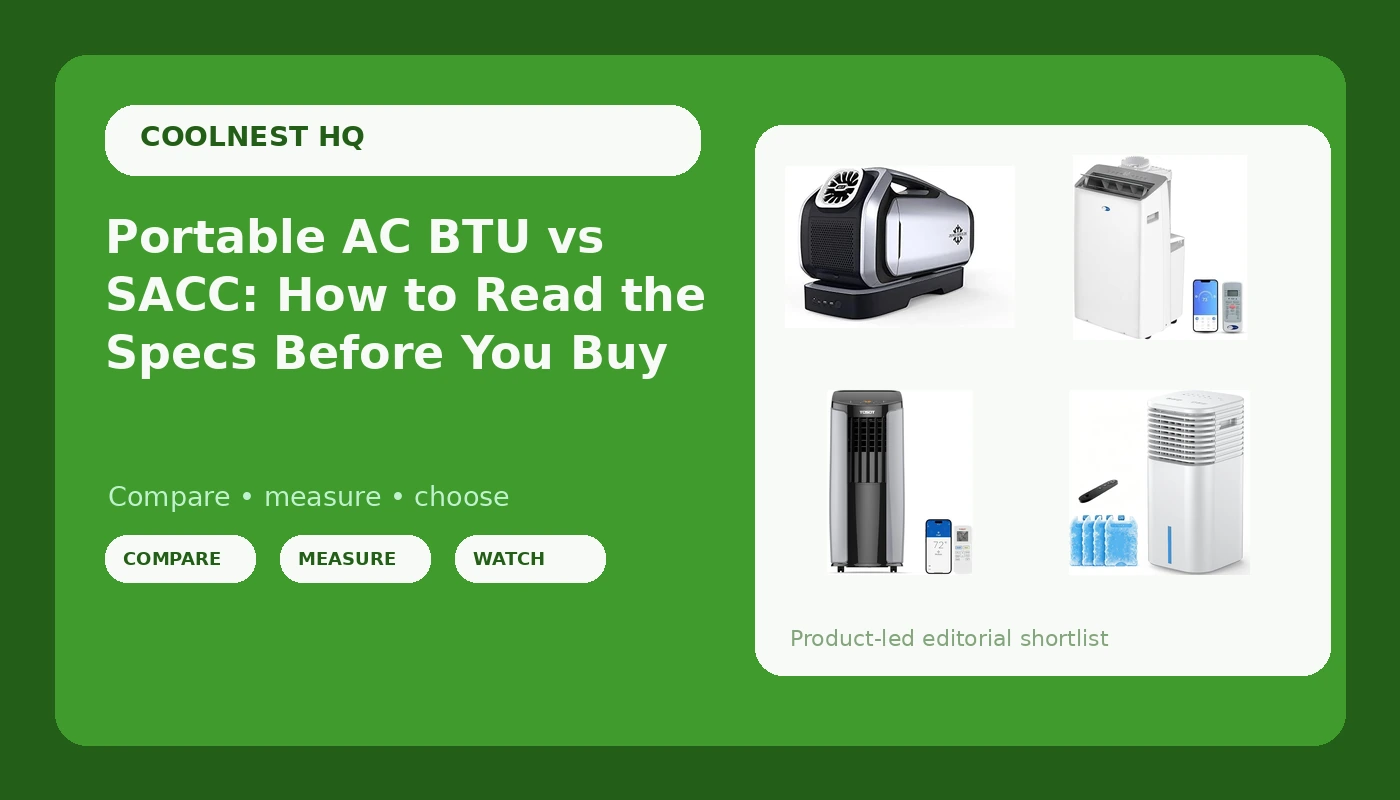
This guide covers four units that solve four different problems: a full-size inverter model for a real room, a small-room unit that prints both numbers in its own listing name, a battery-powered machine built for off-grid use, and a windowless evaporative cooler that never needs a window at all. None of them is a universal answer, and once you know what to read, the spec sheets make that obvious.
Related: Dual Hose vs Single Hose Portable ACs: What Actually Changes →
Quick answer
Compare portables by SACC rating first, hose design second, and condensate handling third. The marketing BTU number is a starting point, not a promise. For a room up to roughly 300 square feet, look for a listing that states a SACC figure and an exhaust setup that does not pull conditioned air straight back out of the room. Battery-powered and evaporative designs are specialist tools: the first is for spaces with no outlet, the second is for dry air only.
Four useful options
| Model | Best fit | What stands out |
|---|---|---|
| Whynter Portable Air Conditioner Inverter 12000 BTU Smart Wi-Fi ARC-1030WN | Larger rooms where efficiency matters | Inverter compressor with smart Wi-Fi control at a 12,000 BTU manufacturer rating |
| TOSOT 9,700BTU (5,000 BTU SACC) Portable Air Conditioner, Smart Wifi Control, AC Unit with Dehumidifier, Fan, Window Kit for Easy Installation, Cool Rooms Up to 300 Square Feet, Shiny Series | Small rooms and bedrooms | States both the marketing BTU and a 5,000 BTU SACC figure in the listing itself |
| Zero Breeze Mark 2 Battery Powered Portable Air Conditioner, 2300 BTU, 240w Low Power Consumption with 24v DC, Off-grid, Design for Outdoor/RV Life | Tents, vans, and off-grid setups | Runs on battery and 24V DC power with a listed 240W draw |
| 3-IN-1 Portable AC Unit with Remote, 24" Windowless Portable Air Conditioner, 15H Timer & 120°Oscillation, 2-Gal Tank, 3 Modes & 3 Speeds, Ultra-Quiet Ventless Swamp Cooler for Home Office, Pearl | Dry-climate spot cooling with no window available | Windowless, ventless design with a 2-gallon tank and a 15-hour timer |
For larger rooms: Whynter Portable Air Conditioner Inverter 12000 BTU Smart Wi-Fi ARC-1030WN
The trade-offs here are the ones that follow any full-size portable. It is heavier than a small-room unit, it needs a window or a vent opening for its exhaust, and the 12,000 BTU figure is the manufacturer's rating rather than the DOE SACC number, so check the current listing for both before you commit. Inverter hardware is the reason to look at this class of machine: variable compressor speed is a genuine engineering difference, not a marketing label, and it is the same technology that made inverter window units popular.
For small rooms: TOSOT 9,700BTU (5,000 BTU SACC) Portable Air Conditioner, Smart Wifi Control, AC Unit with Dehumidifier, Fan, Window Kit for Easy Installation, Cool Rooms Up to 300 Square Feet, Shiny Series
Use that 5,000 BTU SACC figure as your planning number, not the 9,700. A room near the top of the stated 300 square foot range will ask a lot of this machine, especially on a west-facing wall in late afternoon. Where it makes sense is a bedroom, a home office, or a small studio where you want dehumidification and air movement from the same box and you are willing to close the door and let it work on one space.
For off-grid use: Zero Breeze Mark 2 Battery Powered Portable Air Conditioner, 2300 BTU, 240w Low Power Consumption with 24v DC, Off-grid, Design for Outdoor/RV Life
Set expectations correctly and this category makes sense. Battery runtime depends on the battery you pair it with, ambient temperature, and how hard the compressor runs, so treat any runtime claim as conditional. What you are buying is the ability to cool a small, enclosed sleeping space where grid power is not an option, and on that narrow job nothing else in this group competes.
For dry-climate spot cooling: 3-IN-1 Portable AC Unit with Remote, 24" Windowless Portable Air Conditioner, 15H Timer & 120°Oscillation, 2-Gal Tank, 3 Modes & 3 Speeds, Ultra-Quiet Ventless Swamp Cooler for Home Office, Pearl
The rule with evaporative cooling is simple: it works in dry air and fails in humid air. In a desert climate it can take the edge off a hot room and it adds moisture while it runs, which is often welcome. In a muggy climate it adds humidity to air that is already wet, and the result is a fan with a water tank. If your summer air is heavy, this is not the appliance for you, no matter how the listing is titled.
Prices and availability may change. Product images, names, and retailer links are matched to verified listings. No current price, rating, stock status, or measured result is stated here without current evidence.
What the SACC rating actually changes
Before 2020, portable air conditioners were rated with a test that flattered them. The DOE changed the rule to account for the reality of a portable: it sits inside the room it is cooling, it ducts heat out through a hose, and that hose setup affects how much cooling the room actually keeps. The new number is SACC, and on many units it is dramatically lower than the marketing BTU figure, sometimes close to half.
This is not a scandal so much as a correction. The TOSOT listing above shows the gap in plain sight, with 9,700 BTU and 5,000 BTU SACC in the same product name. The practical takeaway is that SACC is the number you compare across brands. A 12,000 BTU marketing rating means very little on its own, because you have no idea which test produced it. A stated SACC figure at least comes from the same standardized method on every box.
Hose design, condensate, and noise
Three physical details decide whether you like a portable after the first week.
Hose design comes first. A single-hose unit pulls room air, uses it to cool the condenser, and dumps that air outside, which means replacement air has to leak in from somewhere, often hot air from outside. A dual-hose unit pulls outside air in for the condenser and sends it back out, so it does not depressurize the room. This is why technicians are wary of single-hose machines sold for large spaces.
Condensate handling comes second. A portable pulls water out of the air, and that water has to go somewhere: a tank you empty, a drain hose, or a system that evaporates it off the condenser. A tank that fills quickly turns a cooling appliance into a chore.
Noise comes third, and it is a specification, not a preference. Compressor cycling, fan speed, and cabinet vibration all land in the same room you are trying to sleep in.
- Find the SACC rating on the listing, not just the marketing BTU number.
- Estimate the square footage of the room and match it against the stated coverage.
- Check whether the unit is single hose or dual hose before you buy.
- Read how condensate is handled: tank, drain hose, or evaporation.
- Confirm whether you have a window or vent path for the exhaust.
Practical guidance before you order
- Measure the room honestly. A 300 square foot claim assumes a normal ceiling height and a closed door.
- Account for sun load. A west-facing window adds heat that no rating sheet mentions.
- Plan the exhaust path first. A portable with nowhere to dump heat is a noisy fan.
- Check the tank or drain plan before the first hot night, not during it.
- For a room under 300 square feet where a window unit is possible, compare that option before buying any portable.
Which option should you choose?
Choose the Whynter Portable Air Conditioner Inverter 12000 BTU Smart Wi-Fi ARC-1030WN when you are cooling a genuinely large room and you want inverter hardware plus app control. Choose the TOSOT 9,700BTU (5,000 BTU SACC) Portable Air Conditioner when the room is small, the door closes, and you want a listing that states its real SACC figure. Choose the Zero Breeze Mark 2 Battery Powered Portable Air Conditioner when there is no outlet at all and you need to cool one sleeping space. Choose the 3-IN-1 Portable AC Unit with Remote when the air is dry, a window is not available, and you want spot cooling without a hose.
Every recommendation here rests on the manufacturer's published specifications, not on a measured test. Verify the current SACC figure, hose configuration, and condensate method on the live listing, because manufacturers revise hardware between production runs.
The bottom line
The BTU number on the box is the least useful thing on the box. Read the SACC rating, then the hose design, then the drain plan, and the four units above sort themselves into obvious roles: a full-size inverter machine for a real room, a small-room unit with an honest rating, a battery model for off-grid sleeping spaces, and an evaporative cooler for dry air and no window. Get those three details right and the sticker stops mattering.