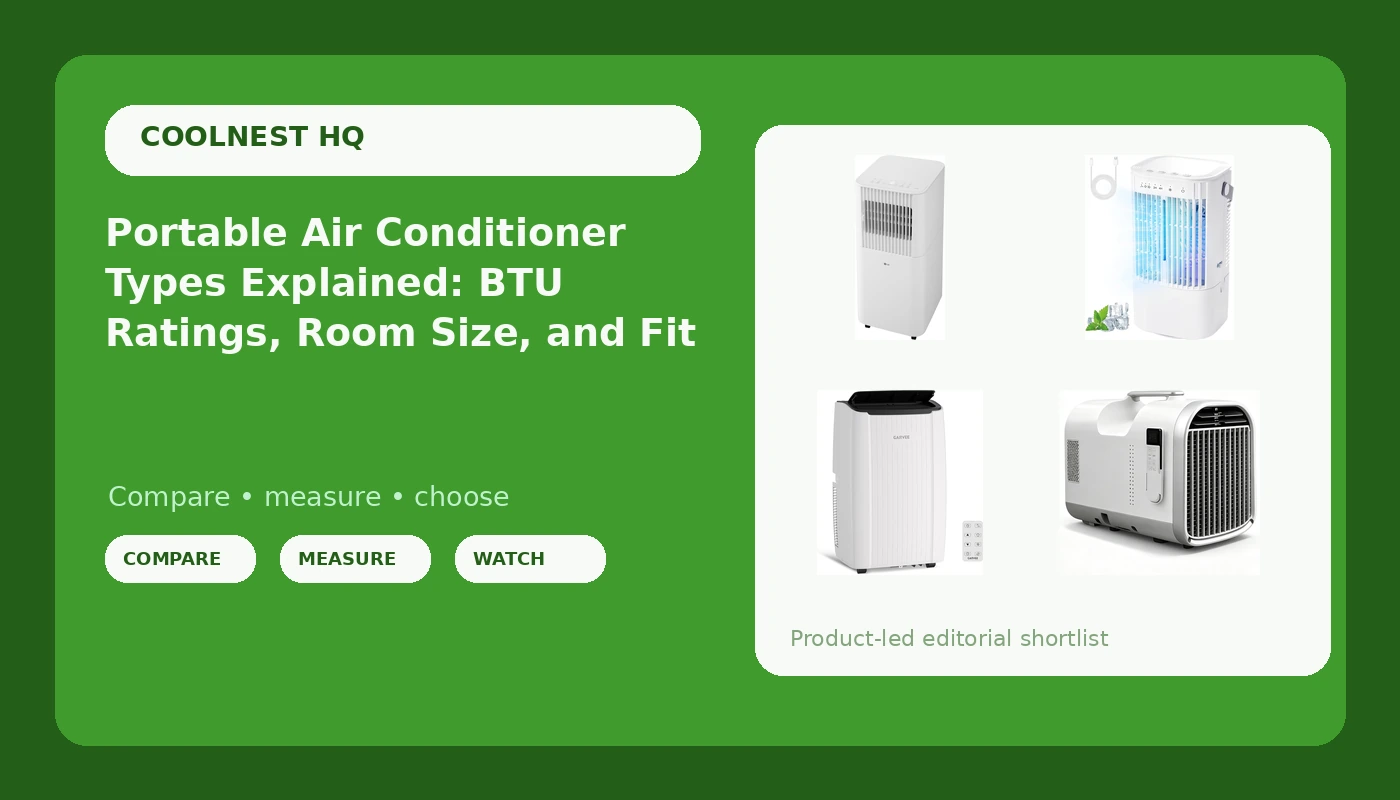
Portable air conditioner shopping usually starts with a bad assumption: that the number on the box tells you how much room the unit will cool. It does not, at least not by itself. The same machine can be advertised at 8,000 BTU under the old ASHRAE figure and 6,000 BTU under the current DOE rating, and only the second number reflects something close to what you will actually feel in a bedroom in August.
That gap is why so many people buy a portable, run it for a week, and then move it to the garage. The other reasons are hose design, condensate handling, and noise. The four options below cover four different jobs: a small-room unit from LG, a 14,000 BTU unit for larger spaces, a 4-in-1 mini cooler for desk-level spot cooling, and a 12V unit built for vehicles.
Related: Why a Portable AC's BTU Rating Is Not the Number on the Box →
Quick answer
Match the unit to the job first, then compare numbers. For a bedroom or office where a window unit will not fit, the LG 6,000 BTU (DOE) / 8,000 BTU (ASHRAE) Portable AC is the most conventional room-cooling option here, and it is the only one of the four that lists both a DOE and an ASHRAE figure. The 14000 BTU Portable Air Conditioner is the pick for a larger room, with the caveat that the manufacturer's "up to 800 Sq. Ft." figure assumes conditions most homes do not have. The 4-in-1 mini cooler is a spot cooler and humidifier, not a room air conditioner. The 12V car unit is for a vehicle cab, an RV, or a tent with power, and it will not cool a house.
4 useful options
| Model | Best fit | What stands out |
|---|---|---|
| LG 6,000 BTU (DOE) / 8,000 BTU (ASHRAE) Portable AC with Wi-Fi and Remote | Small bedroom or office | Lists both a DOE and an ASHRAE rating, plus Wi-Fi and a remote |
| 14000 BTU Portable Air Conditioner | Cools Rooms up to 800 Sq. Ft., with Remote Control & Window Kit, for Home, Bedroom, Office Use | Larger room | Higher listed capacity, remote, and a window kit in the box |
| 4-in-1 Portable Air Conditioner: 1000ml Mini AC Unit Evaporative Cooler with Humidifier, 3 Speeds, 2H/4H Timer, Oscillating Airflow for Bedroom Office Desk Camping | Desk, nightstand, or tent | Evaporative cooling with a humidifier mode, timer, and oscillation |
| Portable Car Air Conditioner 12V Mini AC Unit for RV Truck Camping Travel | Car cab, truck, or RV | Runs on 12V DC instead of a household outlet |
Small-room pick: LG 6,000 BTU (DOE) / 8,000 BTU (ASHRAE) Portable AC with Wi-Fi and Remote
The dual rating is the detail that matters most on this listing. A DOE figure under the 2020 test standard is the number that reflects how a portable performs in a real room, where the machine has to pull its own condenser air and dump heat through a hose. The ASHRAE figure is the older marketing number, and it is almost always the larger of the two. Seeing both on the same page tells you the manufacturer is not hiding behind the bigger one.
What the listing does not spell out is hose count, condensate handling, or decibel level, and those are the three specs that decide whether you keep the unit past the return window. Wi-Fi control does solve one small annoyance, since you can adjust the unit without pointing a remote across the room.
Larger-room option: 14000 BTU Portable Air Conditioner | Cools Rooms up to 800 Sq. Ft., with Remote Control & Window Kit, for Home, Bedroom, Office Use
Treat the 800 square foot claim as a ceiling, not a promise. Square footage ratings assume an eight-foot ceiling, reasonable insulation, and a moderate climate, and they assume the unit is not fighting a west-facing window in the afternoon. A 14,000 BTU portable in a Phoenix living room with single-pane glass and a hot kitchen nearby is a different job than the same unit in a shaded, well-insulated room.
Two things to confirm before buying: whether that 14,000 figure is a DOE rating or an ASHRAE one, and how many hoses the unit uses. A single-hose portable of this size pulls conditioned air out of the room to cool its own condenser, which drops the pressure in the room and drags hot outside air back in through every gap. Higher capacity makes that problem more expensive, not less. Also worth checking: the weight and the window kit's minimum and maximum window height, since a bigger unit needs a bigger opening.
Desk and camping option: 4-in-1 Portable Air Conditioner: 1000ml Mini AC Unit Evaporative Cooler with Humidifier, 3 Speeds, 2H/4H Timer, Oscillating Airflow for Bedroom Office Desk Camping
This is a different category of machine, and the name is honest about it once you read past the first four words. There is no compressor and no refrigerant here. It moves air across a wet pad, and the evaporation does the cooling. That works well in dry heat, which is why evaporative coolers have a long history in the Southwest, and it works poorly in humid air, where there is little evaporation left to do and the added moisture just makes a room feel heavier.
The practical framing is personal space. A unit like this cools the air aimed at you, at desk or pillow distance, and it will not drop the temperature of a bedroom. The 1000ml tank sets the run time, the 2H/4H timer keeps it from running all night, and the oscillation spreads the airflow across a wider arc. In a dry climate it is a reasonable supplement to a real air conditioner, and in a damp one it is a fan with a water tank.
Vehicle option: Portable Car Air Conditioner 12V Mini AC Unit for RV Truck Camping Travel
The 12V rating is the whole story here. This unit runs off a vehicle's electrical system, not a household outlet, so the question is not how many square feet it cools but whether your battery and alternator can feed it. Running one of these off a parked car battery without the engine running is how people end up needing a jump start. Check the amp draw and whether your RV or truck has the capacity to spare.
Set expectations by the job: this is cab cooling and small sleeping-area cooling for travel, trucking, and camping. It is not a substitute for a bedroom air conditioner, and it should not be compared to the room units above on capacity. If your problem is a hot bedroom, this is the wrong product category.
Prices and availability may change. Product images, names, and retailer links must be matched by verified ASIN. Do not state a current price, rating, stock status, or measured result without current evidence.
What the BTU number on the box actually means
Two rating systems are in circulation for portable air conditioners, and the difference between them is large enough to change which unit you buy.
The ASHRAE figure is the older one. It measured cooling capacity under favorable lab conditions, and for years it was the number printed largest on the box. The DOE rating introduced in 2020 measures a portable more realistically, accounting for the fact that a portable has to reject heat through a hose and often pulls its own condenser air from the room it is cooling. When the standard changed, rated capacities on many portables dropped by a third or more. Nothing about the machines changed. The measurement did.
That is why the LG listing here shows 6,000 BTU (DOE) and 8,000 BTU (ASHRAE) for the same unit. When a listing shows only one number, you cannot tell which system it came from, and comparing a lone 14,000 to a DOE 6,000 is not a comparison at all. Ask which standard applies, or compare only DOE to DOE.
The square footage figure is a separate estimate, and it is the softest number in any listing. It assumes an eight-foot ceiling, decent insulation, and a climate that is not actively working against you. A common starting rule is roughly 20 BTU of real capacity per square foot of living space, adjusted upward for sun exposure, kitchens, top floors, and open floor plans, and adjusted upward again if the room has more than two people in it regularly.
Hose design and condensate: the two specs that decide your summer
Hose count is the single most important design detail on a portable air conditioner, and it is the one most listings bury.
A single-hose unit uses one hose to exhaust hot air. That air has to be replaced, and it gets replaced by warm outside air pulled in through door gaps, outlets, and windows. The machine is cooling a room it is simultaneously depressurizing. A dual-hose unit pulls condenser air from outside through one hose and dumps it through the other, so the room's air stays in the room. Dual hose is the design that does not fight itself, and for anything above roughly 10,000 BTU the difference shows up on a thermometer.
Condensate is the second spec. A portable pulls pints of water out of the air every day, and it handles that water in one of three ways: it evaporates it back through the exhaust, it drains by gravity through a hose you route to a floor drain or outside, or it collects in a tank you empty. Tank designs are the ones that turn into a chore. If a listing does not say how the unit handles water, assume you will be dealing with a bucket until you confirm otherwise.
Noise belongs in the same conversation. Compressor noise is not a marketing claim you can verify from a spec sheet, and a bedroom unit that keeps you awake has failed at its job regardless of how cold it gets. Look for a decibel figure and a return policy you are willing to use.
- Measure the room in square feet and note the ceiling height, sun exposure, and how many people use it.
- Decide whether a window unit is possible. If it is, a window unit will cool better for less money and less noise.
- Compare DOE ratings only, never a DOE number against an ASHRAE number.
- Confirm hose count before buying anything above 10,000 BTU.
- Confirm how the unit handles condensate, and check the noise figure and return window.
Sizing, placement, and what to check before checkout
- Size for the room you actually have, not the room you wish you had. Oversizing a portable does not cool faster, it just cycles harder and drains more water.
- Place the unit where the exhaust hose can run short and straight. A long, kinked, or upward-sloping hose traps heat and kills capacity.
- Seal the window kit properly. A loose panel around the hose lets the hot air you just rejected come straight back in.
- Give the unit clearance on all sides. Portables need airflow around the intake and exhaust, and a corner placement chokes them.
- Check the weight and whether it has casters before you plan to move it between rooms or floors.
Which option should you choose?
Choose the LG 6,000 BTU (DOE) / 8,000 BTU (ASHRAE) Portable AC with Wi-Fi and Remote when you need to cool a small bedroom or office and a window unit is not an option, and you want a listing that shows a DOE rating alongside the older figure. Choose the 14000 BTU Portable Air Conditioner when the room is larger and you have confirmed that its rating standard and hose design match what you expect. Choose the 4-in-1 Portable Air Conditioner when you want directed, personal cooling at a desk or bedside in a dry climate, or a humidifier function, and you are not expecting it to cool a room. Choose the Portable Car Air Conditioner 12V Mini AC Unit when the space you need to cool is a cab, a sleeper, or a camper with 12V power available.
None of these listings state hose count, condensate method, decibel rating, or weight, and those four specs decide whether a portable air conditioner works in your room. Confirm them on the listing, and buy from a seller with a return policy you would actually use.
The bottom line
The BTU number on the box is a starting point, not an answer, and the units that disappoint people are usually the ones bought on that number alone. The LG model is the most straightforward room-cooling choice of the four for a small space, largely because it publishes a DOE rating next to the ASHRAE one. The 14,000 BTU unit is the larger-room option, provided its rating standard and hose design check out. The 4-in-1 mini cooler is a spot cooler and humidifier for a desk or a tent, and the 12V car unit is a vehicle product that has nothing to do with cooling a house. Pick the category first, then compare the specs that decide whether you keep it.