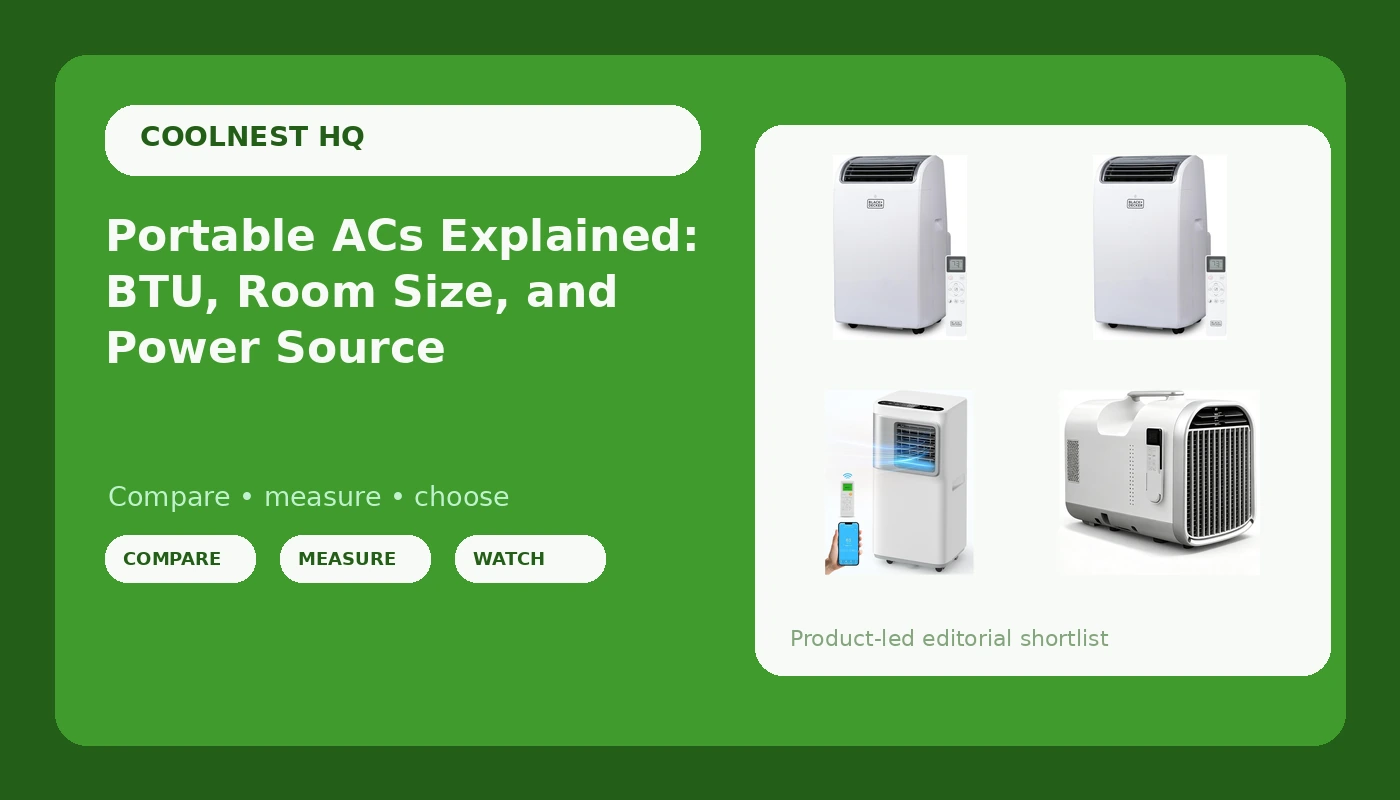
Portable AC BTU sizing is the number that decides whether a unit cools a room or simply stirs warm air around it. Most shoppers read the biggest sticker on the box, buy the highest number they can afford, and then find out that a 14,000 BTU portable behaves very differently in a 730 square foot open living area than it does in a 150 square foot bedroom. The figure on the carton and the cooling the machine actually delivers are not the same measurement, and that gap is where most returns, bad reviews, and disappointing summers come from. This explainer covers four currently available portable cooling products, what separates them, and how to line up capacity, control, and power source with the space you actually have.
Related: Portable AC vs Window Unit: Which One Actually Cools a Bedroom →
Quick answer
Match capacity to room size first, then match the machine to your power source. For a large open room, start with the 16,000 BTU 5-in-1 smart unit, which is the highest capacity option here and the only one rated by its listing for spaces up to 730 square feet. For a bedroom or living room that needs cooling only, a 14,000 BTU smart portable covers the job, and the version with heat covers the same space year round. If the space moves, meaning a truck, an RV, or a campsite, a 12V mini air conditioner is a separate product category, and no household portable substitutes for it.
Four useful options
| Model | Best fit | What stands out |
|---|---|---|
| 16000 BTU Portable Air Conditioners for Large Room up to 730 sq.ft 5-in-1 Smart AC Unit | Large open rooms | Highest capacity here, with dehumidifier and quiet sleep modes plus WiFi app and remote control |
| BLACK+DECKER Smart Portable Air Conditioner, 14,000 BTU, BPACT14WT, White | Bedrooms and living rooms that need cooling only | 14,000 BTU smart portable in a cooling-only configuration |
| BLACK+DECKER Smart Portable Air Conditioner with Heat, 14,000 BTU, White | Spaces that need heat in winter too | Same 14,000 BTU platform with an added heating function |
| Portable Car Air Conditioner 12V Mini AC Unit for RV Truck Camping Travel | Vehicles, RVs, and travel | 12V DC mini unit built for car, truck, and camping use |
Best for large rooms: 16000 BTU Portable Air Conditioners for Large Room up to 730 sq.ft 5-in-1 Smart AC Unit with WiFi APP/Remote Control, Fast Cooling, Dehumidifier, Quiet Sleep Mode, Window Kit Included
Capacity is the reason this unit sits at the top of the group. A portable air conditioner has to remove heat from the room air, push that heat outdoors through a hose, and still keep enough cooling left over to drop the room temperature. The bigger the room, the more of that work is spent just holding the line, which is why a large open living area or a combined kitchen and dining space needs more capacity than a closed bedroom. Higher capacity also usually means a larger cabinet, a heavier unit, and more airflow noise, so the trade is real: you gain coverage and give up portability and quiet. Before buying anything at this capacity, measure the room, note how much sun it gets, and confirm you have a window that can accept a vent kit without the hose kinking or sloping upward.
Best for cooling only: BLACK+DECKER Smart Portable Air Conditioner, 14,000 BTU, BPACT14WT, White
The case for a cooling-only unit is simple: if you live somewhere the cooling season runs long and the heating season does not exist, you are paying for a function you will never use. In Phoenix, where summer does the heavy lifting and winter is mild, a cooling-only portable is the honest purchase. The trade-off is the opposite of what you might expect. A cooling-only machine is not weaker; it simply cannot reverse the cycle and produce heat. If a cold snap or a shoulder-season evening matters to you, this is the wrong pick, and the version with heat below is the one to look at. Otherwise, this is the straightforward middle option in this group.
Best for year-round use: BLACK+DECKER Smart Portable Air Conditioner with Heat, 14,000 BTU, White
Adding heat changes how often the machine earns its footprint. A single-hose or dual-hose portable that only cools sits idle for months; a heat-capable unit can be used in a garage office, a converted porch, or a bedroom that runs cold in January. The trade-off is cost and complexity: heating adds components, and heat-pump style heating in a portable is not the same as a dedicated space heater in cold weather, particularly when outdoor temperatures drop hard. If you need backup heat in a mild-winter climate or a room your central system never reaches, this is the more versatile pick of the two BLACK+DECKER units.
Best for vehicles and travel: Portable Car Air Conditioner 12V Mini AC Unit for RV Truck Camping Travel
The mistake people make with 12V units is expecting room-scale cooling. A mini unit running on a vehicle circuit is built to cool a cab, a sleeper, a tent, or a small RV berth, not a 300 square foot bedroom. Its capacity is limited by what a 12V system can supply, so the honest comparison is against a fan and a bucket of ice, not against a 14,000 BTU household portable. If your problem is a hot truck cab at a rest stop or a camper that bakes in the afternoon, this class of product solves it. If your problem is a hot apartment, this is not the answer, and no amount of ducting will make it one.
Prices and availability may change. Product images, names, and retailer links must be matched by verified ASIN. Do not state a current price, rating, stock status, or measured result without current evidence.
What the BTU number actually means
BTU is a unit of heat, and an air conditioner's rating describes how much heat it can move per hour. The trouble is which test produced that number. Since the DOE's 2020 rule for portable air conditioners, units sold in the United States carry a SACC rating, a seasonally adjusted figure that accounts for the fact that a portable pulls in some of the air it just cooled and has to re-cool it. SACC numbers are typically well below the older ASHRAE-style figures that many listings still quote, which is why a machine advertised as 14,000 BTU may carry a noticeably smaller SACC figure on its energy label. Neither number is fake, but they are not interchangeable, and comparing a SACC figure against a marketing figure is how people end up with an undersized unit. When you shop, look for the rating that matches the test standard, and treat any single big number without a standard attached as a suggestion rather than a measurement.
Hose design, condensate, and noise
Three mechanical details decide whether you will like a portable after the first week.
Hose design comes first. A single-hose portable pulls room air, uses it to cool the condenser, and dumps that air outside. Because the air leaving the room has to be replaced, outdoor air gets drawn back in through every gap in the house, which works against the cooling you paid for. A dual-hose design pulls outside air in for the condenser and pushes it back out, so the room air stays in the room. That is the design that does not fight itself, and it matters more as capacity rises.
Condensate handling comes second. An air conditioner pulls water out of the air as it cools, and that water has to go somewhere: a tank you empty, a gravity drain hose, or a condensate pump. In humid climates a tank can fill faster than you expect, and a unit that needs constant emptying becomes a chore rather than an appliance. Check how the specific model you are considering deals with water before you buy, not after.
Noise comes third. Compressor cycling, fan speed, and cabinet vibration all contribute, and a portable in a bedroom is a machine running a few feet from your head. There is no substitute for reading how a unit is described and how owners describe it in a bedroom, because a machine that cools beautifully and sounds like a jet engine still fails the only test that matters at 2 a.m.
- Measure the room in square feet and note ceiling height, sun exposure, and how many people and appliances generate heat there.
- Identify the window or opening you will vent through, and confirm a kit can sit there without the hose sloping upward or kinking.
- Decide whether the unit needs heat, or whether cooling alone is enough for your climate.
- Confirm the power source: a standard household outlet for room units, or a 12V vehicle circuit for mobile ones.
- Plan drainage and placement before the box arrives, including where the water goes and how far the noise will travel.
Practical guidance
- Size to the room you have, not the room you wish you had. Oversized capacity in a small sealed bedroom can short-cycle and dehumidify poorly, while undersized capacity never catches up in a heat wave.
- Compare ratings produced by the same test standard. A SACC figure and a marketing BTU figure are not the same measurement and should not be lined up side by side.
- Seal the vent opening. A window kit that leaves gaps lets hot outdoor air straight back into the room and undoes the work the compressor just did.
- Plan the drain on day one. Know whether the unit uses a tank, a gravity hose, or a pump, and know how you will route it before you place the machine.
- Keep expectations calibrated for the category. A 12V mini unit is for cabs, sleepers, and tents, and a household portable is for rooms with a window and an outlet. Matching the product to the job matters more than any single spec.
Which option should you choose?
Choose the 16000 BTU Portable Air Conditioners for Large Room up to 730 sq.ft 5-in-1 Smart AC Unit when you are cooling a large, open space and need the highest capacity in this group, along with app control and a dehumidifier function. Choose the BLACK+DECKER Smart Portable Air Conditioner, 14,000 BTU, BPACT14WT, White when you need dependable cooling in a bedroom or living room and have no use for a heating mode. Choose the BLACK+DECKER Smart Portable Air Conditioner with Heat, 14,000 BTU, White when the same room needs conditioning in winter as well as summer. Choose the Portable Car Air Conditioner 12V Mini AC Unit for RV Truck Camping Travel when the space you are cooling is a vehicle, an RV, or a campsite rather than a room in a house.
One caveat applies to all four. Capacity ratings, coverage claims, and feature lists here come from the product listings, not from independent measurement, and portable air conditioner performance depends heavily on room size, insulation, window exposure, and how well the vent is sealed. Verify the current rating standard, the stated coverage, and the power requirements on the listing itself before you commit, and treat any single number as a starting point rather than a guarantee.
The bottom line
Portable AC BTU sizing, room size, and power source are the three questions that decide this purchase, and they are best answered in that order. For a large room, the 16,000 BTU 5-in-1 smart unit is the highest capacity option here and the one whose listing claims the widest coverage. For a standard bedroom or living room, either BLACK+DECKER 14,000 BTU portable fits, with the heating version earning its keep if you need year-round conditioning. For a truck, RV, or tent, the 12V mini unit is the right category and the household portables are the wrong one. Get the capacity right, confirm the vent and the drain, and the rest of the decision tends to take care of itself.