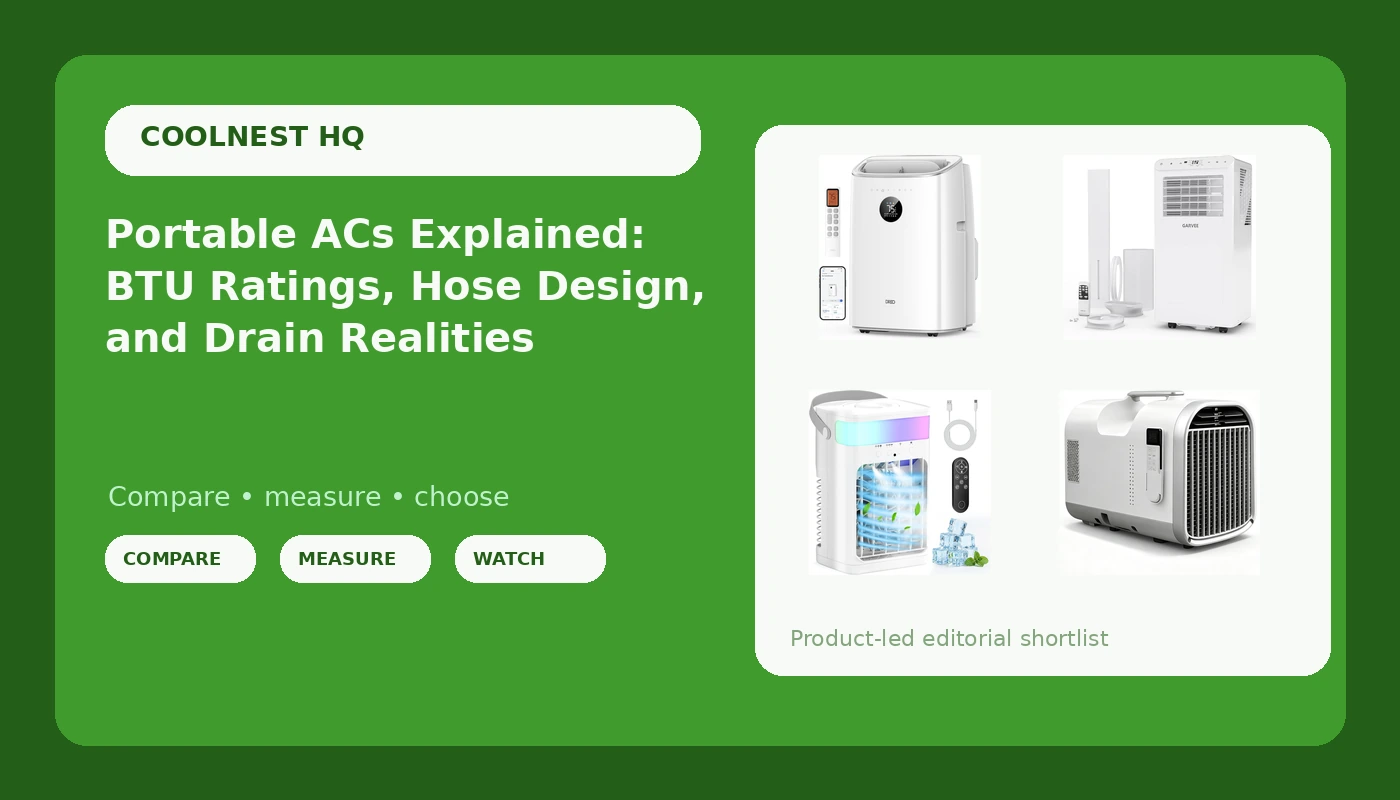
Most people who open a portable air conditioner buying guide are not curious about the category. They have one room that will not cool down, one window that may or may not accept a unit, and a stretch of 100-degree afternoons already on the calendar. The frustrating part is that the number printed largest on the box is the least reliable part of the decision. Two units can both advertise 8,000 BTU and behave nothing alike, because one is quoting the older ASHRAE figure and the other is quoting the DOE figure that replaced it.
The specs that actually decide whether you sleep well are dull ones: the real cooling rating, whether the cabinet uses one exhaust hose or two, how it deals with the water it pulls out of the air, and what it sounds like at 2 a.m. Here is how those specs work, and where four very different products fit into the picture.
Related: How to Size a Portable AC for a Bedroom →
Quick answer
Match the machine to the job rather than to the sticker. For an ordinary bedroom where a window unit is not an option, a compressor-driven portable rated around 5,000 to 8,000 BTU under the DOE standard is the realistic target, and a dual-hose design at the same rating will outperform a single-hose one. If the room is a truck cab, an RV, or a tent, you are shopping in a different category entirely and need a 12V unit. If all you want is moving air and a cool mist at a desk, a water-tank spot cooler is the honest description, and it should not be expected to cool a room.
Four useful options
| Model | Best fit | What stands out |
|---|---|---|
| Garvee 8000 BTU Portable Air Conditioners,Up to 350 Sq.Ft. Remote Control 48dB Portable AC Unit, Dehumidifier, Fan, Sleep, 24H Timer&Installation Kit, DOE Certified, Ceer 6.2,White+White Panel | A bedroom or living area with a window that can take a vent kit | DOE certified listing with a CEER 6.2 efficiency figure, 24-hour timer, sleep mode, and an installation kit in the box |
| DREO Portable Air Conditioner 318S, 8000 BTU ASHRAE (5000 BTU DOE) Smart AC Unit for Bedroom with Drainage-free Cooling, Fan&Dehumidifier 3 in 1, APP/Voice/Remote, Quiet Standing AC for Room Indoors | A small bedroom where you would rather not babysit a drain | Drainage-free cooling design plus app, voice, and remote control |
| Portable Car Air Conditioner 12V Mini AC Unit for RV Truck Camping Travel | A truck, RV, or campsite with 12V power available | Runs on 12V DC instead of household AC power |
| Portable Air Conditioners,Air Conditioner,Ac Unit with 1600ML Water Tank,2 Spray Ports,3 Wind Speeds,3 Timers,10 kinds of Colorful Lights,Portable Ac Units for Room Camping Car Office | Desk-side or tent-side spot cooling in dry air | 1,600 ml water tank, two spray ports, three speeds, three timers, and ten light colors |
The window-venting compressor unit: Garvee 8000 BTU Portable Air Conditioner
The useful detail here is the CEER figure. CEER is an efficiency rating for room air conditioners, and a listing that publishes it is at least telling you how much power the unit draws per unit of cooling. The stated coverage of up to 350 square feet deserves a skeptical eye, though, and this is where the hose question matters. A portable that has to pull its cooling air from inside the room is fighting itself, and the larger the room, the worse that fight gets. Before buying, confirm whether the cabinet is single or dual hose, because that single fact will affect real performance more than any timer feature.
The second trade-off is condensate. The listing does not promise drainage-free operation, which means you should plan on either a gravity drain line running to a floor drain or window, or periodic emptying. That is not a defect, it is simply how most compressor portables behave in humid air.
The drainage-free smart unit: DREO Portable Air Conditioner 318S
Two numbers on one product label is not a contradiction, it is a timeline. The DOE rating is the one to compare against other units, and 5,000 BTU DOE puts this squarely in small-room territory: a bedroom, a home office, a nursery. Buy it expecting to cool one room, not a floor.
The drainage-free design is the feature that will matter most to people who have owned a portable before, because emptying a tank is the chore that turns a cooling appliance into a second job. In very humid climates, drainage-free designs can still reach a point where the internal reservoir fills faster than it evaporates, so keep an eye on it during the first heat wave. The app, voice, and remote controls are conveniences layered on top of cooling, and they are worth exactly as much as the cooling underneath them.
The 12V travel unit: Portable Car Air Conditioner 12V Mini AC Unit
The appeal of a 12V unit is obvious to anyone who has slept in a hot truck cab or an RV without a working roof air. The limitation is equally obvious to anyone who has done the electrical math. A 12V outlet delivers a limited amount of power, so the cooling capacity available is a fraction of what a household circuit supports. Expect directed cooling toward a bunk or a seat, not a room-sized temperature drop.
Before buying, check two things: the amperage rating of the outlet you plan to use, and whether you need the engine running or a deep-cycle battery to sustain it. Running a 12V cooler off a starting battery with the engine off is a reliable way to need a jump start.
The water-tank spot cooler: Portable Air Conditioner with 1600ML Water Tank
Set expectations correctly and this little unit makes sense. It moves air, adds moisture, and gives you a cooler-feeling breeze at close range, which is genuinely pleasant in dry heat and useful in a tent or at a desk. It cannot lower the temperature of a closed room, and in humid climates adding moisture to the air works against you rather than for you.
The water tank is the trade-off: 1,600 ml gives you a limited run time before a refill, so it is best treated as a personal device that follows you rather than an appliance that conditions a space.
Prices and availability may change. Product images, names, and retailer links must be matched by verified ASIN. Do not state a current price, rating, stock status, or measured result without current evidence.
What the BTU numbers actually mean
For decades, portable air conditioners were labeled with an ASHRAE cooling figure that measured the unit under lab conditions that flattered it, including heat from the condenser that never really left the room. In 2020, the DOE introduced the SACC rating, a measurement intended to reflect how the unit actually performs in a home, with the exhaust heat accounted for. The practical result is that the number most shoppers recognize roughly halved. A portable sold as 8,000 BTU might carry a DOE rating of 5,000 BTU, and both figures can appear on the same box.
This matters because sizing decisions are usually made from the bigger number. The old rule of thumb of about 20 BTU per square foot was already generous for portables, and it assumed a unit that met its rating. A more useful approach is to find the DOE rating first, then compare that against the room. Small bedrooms generally fall in the 5,000 to 8,000 BTU DOE range, and rooms much larger than that are better served by a window unit or a dual-hose portable with a genuinely high rating.
Do not oversize either. A portable that cycles off before it has run long enough to pull humidity out of the air leaves a room that feels clammy at the same temperature.
Hose design and condensate: the two specs that decide your summer
Hose design is the spec that separates a portable that works from a portable that spins its wheels. A single-hose unit pulls air out of your room to cool its condenser, then dumps that air outside. Because the room is now at negative pressure, replacement air gets pulled in through every gap in the house, and in summer that replacement air is hot. The unit is partly cooling air it just dragged in from outside. A dual-hose design pulls condenser air from outside and exhausts it back outside, so the room is not depressurized.
Condensate is the second deciding spec, and it is the one people discover only after the first humid week. When warm humid air hits the cold evaporator coil, water comes out of it. Units handle that water in one of three ways: a gravity drain hose you route to a floor drain or outside, a condensate pump that pushes it uphill, or a drainage-free design that flings and evaporates the water back across the coil. Each has a place, and the choice depends on your climate and how much you enjoy carrying buckets.
- Measure the room in square feet and note the ceiling height and sun exposure.
- Find the DOE or SACC rating on the listing, not just the headline BTU figure.
- Confirm whether the cabinet is single hose or dual hose before you commit.
- Decide how the unit will dispose of condensate: gravity drain, pump, or drainage-free.
- Check the circuit and outlet you plan to use, and whether the window can accept the vent panel.
Practical guidance
- Seal the vent panel and hose connection. Gaps around the window insert undo a lot of the cooling you paid for.
- Keep the exhaust run short and straight. A long, kinked hose traps heat and back pressure.
- Give the unit clearance on all sides so the condenser can reject heat.
- Put the unit on a level surface if it has a gravity drain, or the water will find the wrong path.
- Plan for noise placement. If it sits next to the bed, every unit becomes loud at 3 a.m.
Which option should you choose?
Choose the Garvee 8000 BTU Portable Air Conditioner when you need a conventional window-venting compressor portable with an installation kit included and a published efficiency rating. Choose the DREO Portable Air Conditioner 318S when the room is a bedroom or office and drainage-free operation matters more to you than coverage. Choose the Portable Car Air Conditioner 12V Mini AC Unit when the space to be cooled is a truck cab, RV, or campsite with 12V power available. Choose the Portable Air Conditioner with 1600ML Water Tank when you want a personal misting fan for a desk, tent, or seat and you are not expecting room cooling.
One caveat applies to all four. The performance numbers in these listings are manufacturer figures, not measurements taken in your house, with your windows, and your humidity. The room, the vent installation, and the climate will move the result more than any single feature on the box.
The bottom line
The honest hierarchy for portable cooling has not changed: a correctly sized window unit beats a portable in almost every room where one can be installed, and a dual-hose portable beats a single-hose portable at the same rating. Within the portable category, the deciding factors are the DOE cooling rating, the hose design, and how the unit handles condensate, in that order. The Garvee covers the standard bedroom case with an efficiency figure published, the DREO 318S shows you both BTU numbers and removes the drainage chore, the 12V unit serves vehicles rather than rooms, and the water-tank cooler is a personal misting fan that should be judged on that basis. Pick the one that matches the space, then check the venting before the first heat wave arrives.