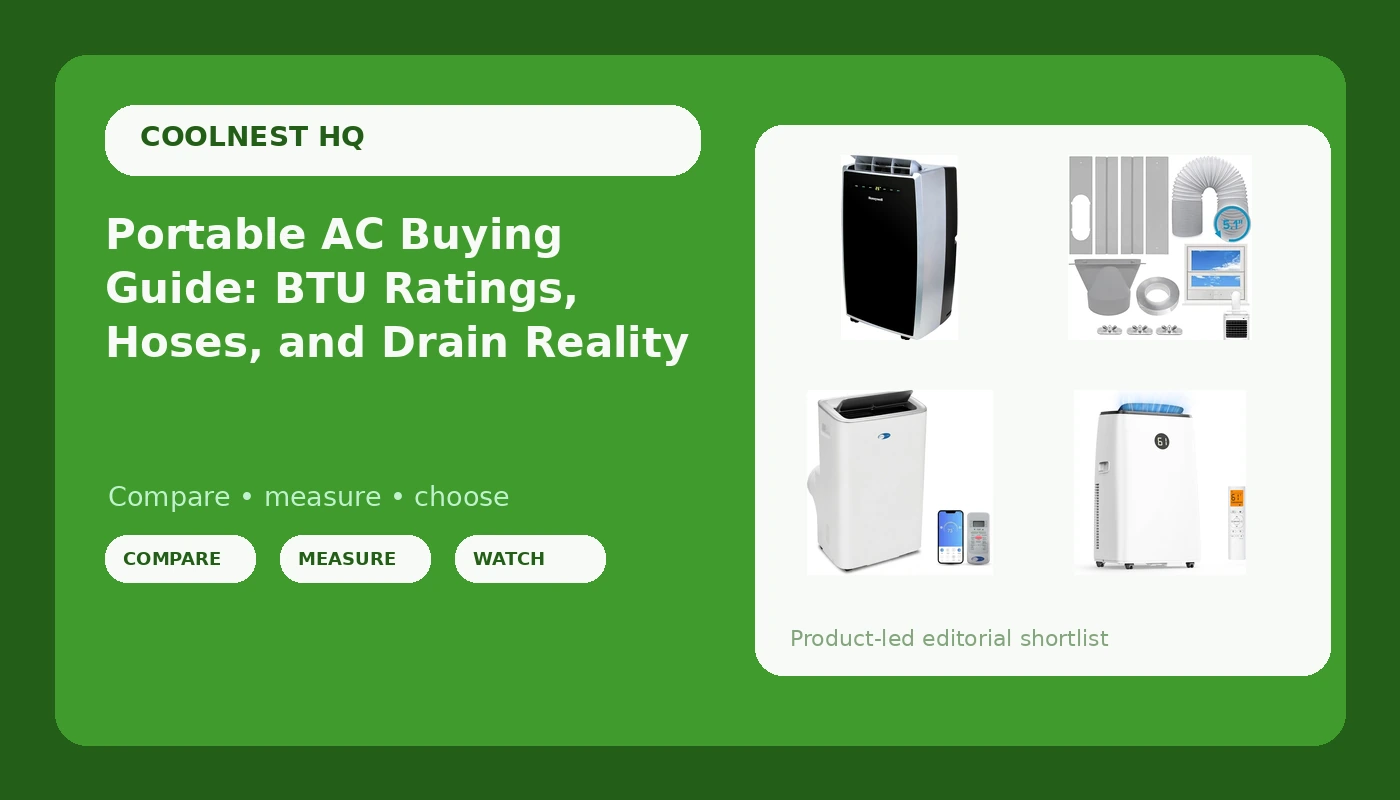
A portable AC buying guide usually starts with the BTU number printed on the box, and that number is the first thing that can send you wrong. Portable air conditioners get described two ways: a marketing figure that flatters the compressor, and a tested capacity figure that reflects what the machine actually pulls out of a room once the hoses, the window, and the heat load are part of the picture. Shop by the first number and you end up with a unit that runs all afternoon and never gets a bedroom below 80. Shop by the second, plus a hose design that does not fight itself, and a portable can hold a room through a desert summer.
This is not a ranking of every portable on the market. It is a walk through the four options in this guide, what each one is built for, and the specifications that decide whether a portable AC earns its floor space. The goal is straightforward: choose a unit that can move heat out of the room, vent it through a sealed window, and handle the water it condenses out of the air without turning you into a bucket carrier.
Related: How to Vent a Portable AC When Your Window Will Not Fit the Panel →
Quick answer
Match the unit to the room, not to the sticker. A 10,000 BTU single-hose portable is a reasonable fit for a small bedroom or office where a window unit is not allowed. A dual-hose 13,000 BTU model is the better shape for a larger room, because one hose brings outside air in for the condenser and the second pushes hot air back out. A floor-standing 14,000 BTU unit makes sense when you want the air outlet higher in the room and a smaller window footprint. If your window is a slider or a vertical casement, plan on a proper window seal kit, because the stock panel in most boxes leaks. Whichever unit you pick, check how it handles condensate before you buy. A machine that drips into a tray you empty twice a day is a chore, not an appliance.
Four useful options
| Model | Best fit | What stands out |
|---|---|---|
| Whynter Portable Air Conditioner 13000 BTU Dual Hose Smart Wi-Fi ARC-1280WX | Larger rooms and buyers who want app control | Dual-hose design, 13,000 BTU rating as listed, Wi-Fi smart control |
| Honeywell MN10CES 10,000 BTU Portable Air Conditioner | Small bedrooms and home offices where a window unit is not permitted | 10,000 BTU rating as listed in a compact, single-hose class cabinet |
| 14000BTU Portable Air Conditioners, Floor Stand Portable AC Unit | Rooms where you want the supply air higher and floor layout is flexible | Floor-standing tower format with a 14,000 BTU rating as listed |
| Portable Air Conditioner Window Kit with 5.1" Exhaust Hose Universal Window Seal for Sliding or Vertical Windows | Sliding and vertical windows that no stock panel fits | 5.1 inch exhaust hose plus a universal seal for sliding or vertical windows |
Dual-hose option: Whynter Portable Air Conditioner 13000 BTU Dual Hose Smart Wi-Fi ARC-1280WX
The dual-hose layout is the reason this unit sits at the top of the table for larger rooms. A single-hose portable pulls room air through the condenser and dumps it outside, which means the air it just cooled is being spent on its own exhaust, and the room is left with a slight negative pressure that pulls hot outdoor air back in through every gap. Two hoses break that loop. The trade-offs are real: two hoses mean two window penetrations or a wider panel, more bulk to store in the off season, and a heavier cabinet to move. If your room is small, that extra hardware buys you less than it costs.
Small-room option: Honeywell MN10CES 10,000 BTU Portable Air Conditioner
Single-hose portables live or die on installation quality. Because the unit exhausts room air, every unsealed inch of window panel becomes a path for hot outside air to replace what the hose just threw away. Seal the panel with foam or weatherstrip, keep the exhaust hose as short and straight as the window allows, and the same 10,000 BTU rating performs noticeably better than it does with a loose panel and a hose coiled behind the curtain. This is also the class where a room under about 300 square feet makes the most sense, and where a window unit would beat it outright if your lease and your window allowed one.
Floor-standing option: 14000BTU Portable Air Conditioners, Floor Stand Portable AC Unit
Height is an underrated variable. Cold air stratifies, and a unit that discharges near the floor can leave the upper half of a room warm while the thermostat, sitting in the cool layer, decides the job is done. A taller cabinet that throws air at chest height mixes the room better. The costs are practical ones: a tower needs vertical clearance, it is awkward to carry up stairs, and at this capacity the condensate load is larger, which makes the drain question more urgent than it is on a 10,000 BTU unit.
Window accessory: Portable Air Conditioner Window Kit with 5.1" Exhaust Hose Universal Window Seal for Sliding or Vertical Windows
Hose diameter is the compatibility detail people miss. A 5.1 inch hose matches the exhaust outlet on many portable ACs, but not all of them, so measure the outlet collar on your unit before ordering. The second check is window type. A sliding window or a vertical casement needs a tall, narrow seal rather than the wide, short panel that ships with most units, and the gap around a poorly fitted panel is exactly where a single-hose portable loses its advantage.
Prices and availability may change. Product images, names, and retailer links are matched to verified listings. No current price, rating, stock status, or measured result is stated here without current evidence.
Why the number on the box is not the number that cools your room
Portable air conditioners have carried two capacity figures since the DOE test standard changed in 2020. The older figure describes the compressor under favorable laboratory conditions. The newer figure, often called the SACC rating, accounts for the fact that a portable sits inside the room it is cooling, vents through a hose, and loses capacity to heat gain in the ductwork and the cabinet. For many units the tested number lands well below the marketing number, which is why two portables advertised at the same BTU can behave like very different machines.
Heat load matters just as much as capacity. A west-facing bedroom with single-pane glass and a computer running in the corner asks far more of a unit than a shaded interior office of the same square footage. Ceiling height, insulation, and how many people occupy the room all shift the requirement. A portable rated at 14,000 BTU in a small, shaded room will cycle and hold temperature comfortably. The same unit in a large, sun-baked space with an open doorway to the rest of the house will run continuously and still lose ground.
Single hose versus dual hose, and what each does to the room
A single-hose portable uses one hose to push hot condenser air outside. That air has to be replaced, and it gets replaced by air pulled in from outside through window gaps, door frames, and the same hose path it just used. The unit ends up cooling a moving target. This is not a fatal flaw in a small room, and single-hose units are simpler, lighter, and cheaper to move around, but the design has a ceiling on how well it performs in a large space.
A dual-hose portable separates the two air paths. One hose supplies outdoor air to the condenser, the second sends it back out hot, and the conditioned air inside the room stays in the room. The result is a more stable room and less pressure imbalance, at the cost of a bulkier installation and a second opening at the window. In a room above roughly 300 square feet, that trade is usually worth making.
- Measure the room in square feet and note sun exposure, ceiling height, and how many people use it.
- Compare the tested capacity figure on the listing against the marketing BTU number before you decide a unit is big enough.
- Decide whether the room can tolerate single-hose pressure loss or needs a dual-hose design.
- Measure the window opening and confirm the exhaust hose diameter matches the unit you are considering.
- Check how the unit manages condensate: built-in evaporation, a gravity drain hose, or a tray you empty by hand.
Practical guidance before you buy
- Seal the window panel with foam or weatherstrip. On a single-hose unit this single step changes the result more than any spec on the box.
- Keep the exhaust hose short, straight, and off the floor. A coiled or kinked hose traps heat and chokes airflow.
- Plan the drain before the first heat wave, not during it. Gravity drain to a floor-level outlet or a condensate pump beats a tray you empty by hand.
- Give the unit clearance on all sides and keep it out of direct sun. A cabinet baking in a window loses capacity before it starts.
- Confirm the circuit. Portable ACs draw serious current, and a shared bedroom circuit with a space heater or a gaming PC is a breaker trip waiting to happen.
Which option should you choose?
Choose the Whynter Portable Air Conditioner 13000 BTU Dual Hose Smart Wi-Fi ARC-1280WX when the room is large enough that pressure loss matters and you want app control for scheduling. Choose the Honeywell MN10CES 10,000 BTU Portable Air Conditioner when the room is small, a window unit is not an option, and you are willing to seal the window properly. Choose the 14000BTU Portable Air Conditioners, Floor Stand Portable AC Unit when you want the supply air delivered higher in the room and have vertical space for a tower cabinet. Choose the Portable Air Conditioner Window Kit with 5.1" Exhaust Hose Universal Window Seal for Sliding or Vertical Windows when your window is a slider or a vertical casement and the panel in the box does not fit.
One caveat applies to all four. The figures quoted here come from the listings, not from an instrumented test, and portable AC performance depends heavily on installation, window sealing, outdoor temperature, and the room itself. Verify the current specifications, hose diameter, and drain method on the product page before you commit, and treat any capacity claim as a starting point rather than a guarantee.
The bottom line
A portable AC is a compromise machine, and the compromise gets better or worse depending on three decisions: how much real capacity you buy, whether the hose design fights itself, and how well the window is sealed. For a small room, the 10,000 BTU Honeywell plus a properly sealed panel is a sensible package. For a larger room, the dual-hose Whynter is the shape that makes the most sense. The floor-standing 14,000 BTU unit covers the case where you want capacity and a higher air outlet, and the window kit exists for the sliding and vertical windows that stock panels ignore. Get the venting and the drain right and any of them will do the job they were sized for.