A dual hose portable air conditioner is the only portable design that cools a room without working against itself, and it is the first thing worth checking on any listing. Most shoppers do the opposite. They read the big BTU number, match it to the square footage on the sticker, and buy whatever clears the math at the lowest cost. Then the hottest week of the year arrives, the bedroom sits in the mid 80s, and the machine turns out to be a fan with a hose attached. The gap between the marketing BTU and the real cooling number is not a small rounding error. It is often close to half.
This is not a list of claims about how each unit performed in my truck. It is an explanation of what the specs on a portable AC listing actually measure, how hose count and condensate handling change the job you are signing up for, and where four current options fit: a bedroom, a garage, a camper, or a tent.
Related: Portable AC vs Window Unit: Which One Actually Cools a Bedroom? →
Quick answer
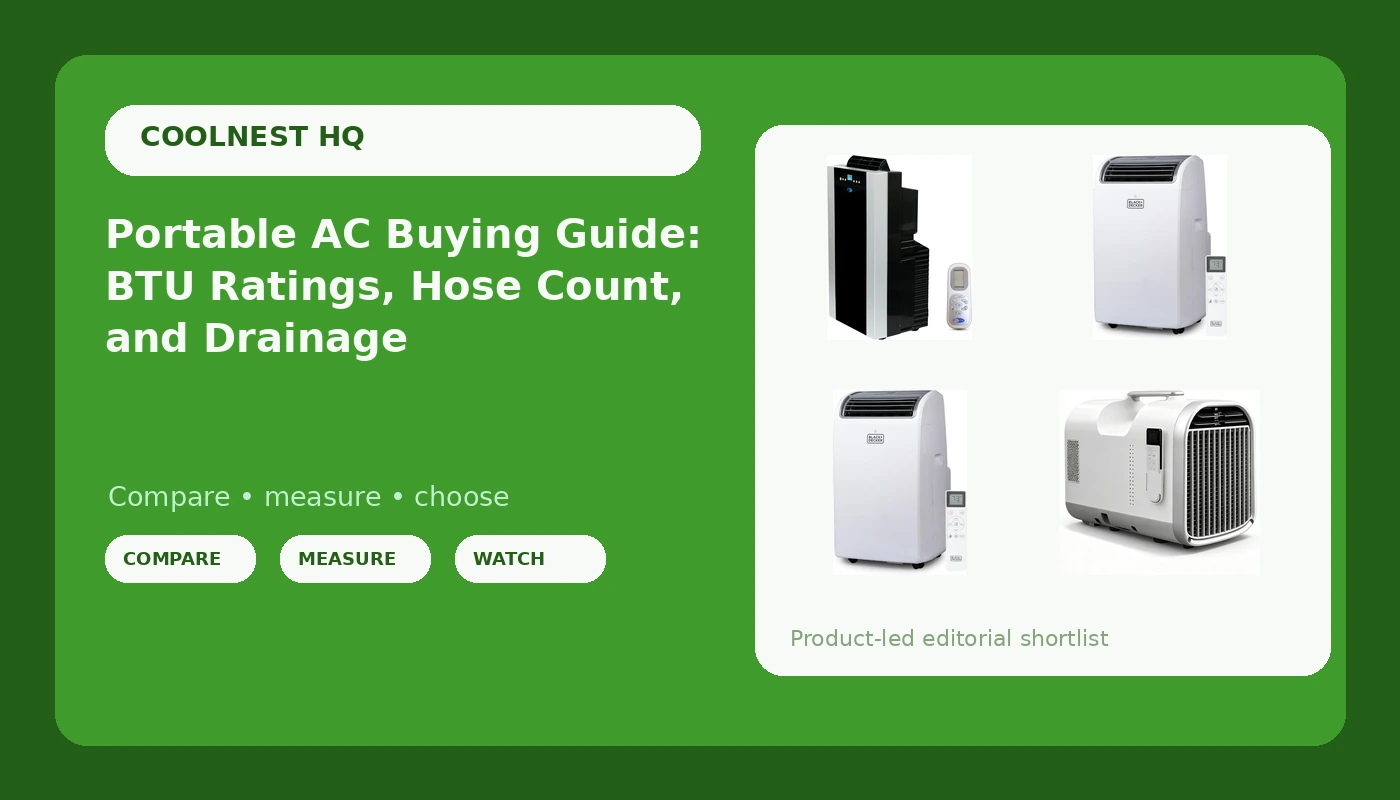
For a bedroom or living room with a window or sliding door you can vent, choose a dual hose unit such as the Whynter ARC-14S, because it pulls in outside air for the condenser instead of stealing cooled air from the room. For a smaller space where a single vent path is all you have, a 14,000 BTU smart portable like the BLACK+DECKER BPACT14WT is the simpler install. If you also want heat for shoulder seasons, the BLACK+DECKER model with heat adds that function. If there is no wall outlet and no window, the 12V mini unit is the only one of the four that runs on vehicle power.
Four useful options
| Model | Best fit | What stands out |
|---|---|---|
| Whynter Portable Air Conditioner 14,000 BTU Dual Hose 500 Sq Ft ARC-14S | Bedrooms and open living areas with two vent paths | Dual hose design listed with a 500 sq ft coverage figure |
| BLACK+DECKER Smart Portable Air Conditioner, 14,000 BTU, BPACT14WT, White | Cooling only, smaller rooms, app control | 14,000 BTU class with smart controls in a single unit |
| BLACK+DECKER Smart Portable Air Conditioner with Heat, 14,000 BTU, White | Year round use where winters are mild | Cooling plus heating in one cabinet |
| Portable Car Air Conditioner 12V Mini AC Unit for RV Truck Camping Travel | RVs, trucks, campers, and tents | Runs on 12V DC power instead of a household outlet |
The big-room pick: Whynter Portable Air Conditioner 14,000 BTU Dual Hose 500 Sq Ft ARC-14S
The dual hose design is the reason this one sits at the top of the list. A single hose unit pushes air outside, which lowers the pressure in your room, and that air has to come back in from somewhere. It comes back in through gaps around doors and outlets as hot outdoor air. A dual hose unit avoids most of that exchange by drawing condenser air from outside and dumping it back outside. The trade off is bulk and setup: two hoses to route, a wider window kit, and a heavier cabinet to move. Confirm the coverage figure and the venting requirements on the current listing before you commit to it for a specific room.
The cooling-only pick: BLACK+DECKER Smart Portable Air Conditioner, 14,000 BTU, BPACT14WT, White
This is the pick for someone who wants a bedroom cooled down and does not need heat, a heater, or a second hose to manage. The smart label points to app based control, which is useful for pre cooling a room before you get home, but the exact app features and the hose configuration belong to the listing, not to the model name. Read the venting section carefully. If the room only offers one usable vent path and the unit is single hose, plan on a warmer room than the headline BTU suggests, and seal the window kit as tightly as you can.
The heat and cool pick: BLACK+DECKER Smart Portable Air Conditioner with Heat, 14,000 BTU, White
Heating mode on a portable is not the same as a furnace. It is a heat pump function, and heat pump output falls as outdoor air gets colder, so treat it as a supplement for mild cold rather than a replacement for a real heating system. Where it earns its place is the space that is uncomfortable in both directions: a converted garage, a workshop, a sunroom that bakes in July and chills in January. The cost is one more mode to maintain and a cabinet that has to sit somewhere year round. Check the listing for the heating capacity figure, since it is usually lower than the cooling figure.
The vehicle and tent pick: Portable Car Air Conditioner 12V Mini AC Unit for RV Truck Camping Travel
This one is a different category, and it should be judged that way. It is not going to cool a 500 sq ft living room, and it is not meant to. It is meant for a bunk, a cab, or a small enclosed space where a 120V portable cannot go. Before buying, confirm two things on the listing: the plug type and the current draw. A 12V compressor pulls meaningful amperage, and a long run on battery power alone will drain a bank faster than most people expect. If you have shore power or a running engine, the math is much friendlier.
Prices and availability may change. Product images, names, and retailer links must be matched by verified ASIN. Do not state a current price, rating, stock status, or measured result without current evidence.
What the BTU number on the box actually means
For decades, portable air conditioner packaging used a BTU figure that described the compressor, not the cooling delivered to the room. The gap between that number and reality was large enough that the Department of Energy introduced a separate rating for this product category, the SACC rating, which stands for Seasonally Adjusted Cooling Capacity. SACC accounts for the heat a portable pulls back into the room through its own hose setup and cabinet losses. On many single hose models, the SACC figure lands far below the headline BTU number, which is why a unit labeled 12,000 BTU can struggle in a bedroom that a 5,000 BTU window unit would handle.
So when you compare the four options above, do not stop at the number in the model name. Look for the SACC or DOE rating in the listing details, look at the amperage or watt draw, and look at the recommended room size. If a listing gives a coverage figure with no test standard attached, treat it as a manufacturer claim and size down rather than up. Oversizing a portable does not help the way it helps a central system. It just cycles harder and leaves the room clammy.
Hose count, venting, and condensate
Hose count is the single most useful spec on a portable AC listing, and it is often buried. A single hose unit uses one duct to exhaust hot air. That air has to be replaced, and the replacement comes from outside, through every gap in the room. A dual hose unit runs two ducts, one bringing outside air to the condenser and one sending it back out, so the room air stays in the room. The Whynter ARC-14S is the dual hose option in this group. For the other units, verify the hose configuration in the listing photos and specifications before you assume.
Condensate is the other spec that decides whether you enjoy the machine or resent it. An air conditioner pulls water out of the air as it cools. Some portables evaporate that water back out through the exhaust, and some collect it in a tank or require a gravity drain hose. In a dry climate, this is a minor chore. In a humid one, a tank that needs emptying every few hours turns a cooling appliance into a part time job. Check how each unit handles water and whether a continuous drain option exists.
- Measure the room in square feet and note how much sun it takes during the hottest part of the day.
- Find the SACC or DOE rating in the listing, not just the BTU figure in the model name.
- Count the hoses. Dual hose if two vent paths are possible, single hose only where they are not.
- Read the condensate section to see whether there is a tank, a drain hose, or evaporation.
- Decide the power source. A 120V wall outlet opens three of these options; 12V DC is a separate path.
Practical guidance
- Seal the window kit. A loose vent panel lets hot air back in and undoes the work the unit is doing.
- Keep the unit out of direct sun if you can. Solar gain on the cabinet itself is cooling capacity you paid for and did not get.
- Give the exhaust hose a short, straight run. Long loops trap heat and reduce airflow.
- Clean the filter on a schedule. A clogged filter is the most common reason a portable stops keeping up.
- Do not expect a portable to match a window unit in the same room size. That is a design limit, not a defect.
Which option should you choose?
Choose the Whynter Portable Air Conditioner 14,000 BTU Dual Hose 500 Sq Ft ARC-14S when you have two vent paths, a larger room, and you want the design that does not fight itself. Choose the BLACK+DECKER Smart Portable Air Conditioner, 14,000 BTU, BPACT14WT, White when you need cooling only, want smart controls, and have a simpler venting situation. Choose the BLACK+DECKER Smart Portable Air Conditioner with Heat, 14,000 BTU, White when the same room is uncomfortable in winter as well as summer. Choose the Portable Car Air Conditioner 12V Mini AC Unit for RV Truck Camping Travel when the space is a vehicle, a camper, or a tent and there is no household outlet to plug into.
One caveat on all four: the coverage figures, hose configurations, and smart features described here come from the manufacturer names and product descriptions. Verify them against the current listing before purchase, and do not assume a heating mode or an app feature exists just because a similar model has one.
The bottom line
The portable AC market rewards careful reading and punishes optimism. Match the hose configuration to the venting you actually have, look for the SACC rating instead of the sticker BTU, and check how the unit deals with condensate before you buy. Do those three things and any of these four units will do the job it was designed for. Skip them and the most expensive option on the page can still leave you sleeping in a warm room.