A portable air conditioner has to solve a problem that a central system or a window unit already solves better, so the decision usually comes down to why neither of those will work for you. Maybe the window opens outward, maybe the building will not allow a bracket, maybe the room has no exterior wall that takes a unit. Once you are in that situation, the specs matter more than the brand, and the most important spec is often the one printed in the smallest type. This explainer covers four currently listed portable cooling options, what their listings actually state, and how the numbers behind a portable air conditioner relate to the room or vehicle you are trying to cool.
Related: How to Size a Portable AC Without Guessing →
Quick answer
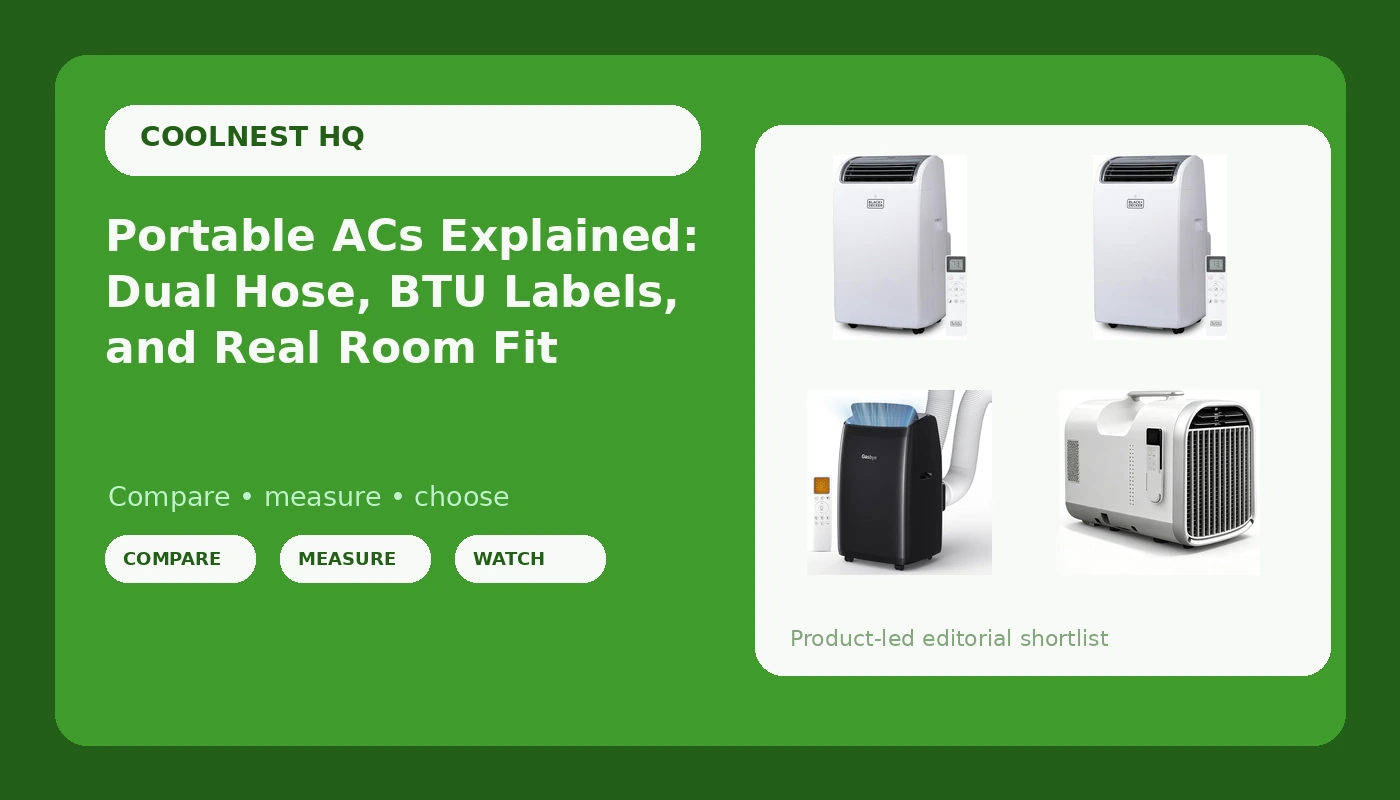
Among the four units here, the Gasbye Dual Hose model is the only one whose listing describes a dual hose configuration, a full DC inverter compressor, and a 13.6 CEER efficiency rating, which makes it the strongest fit for a large room. The BLACK+DECKER with Heat adds a heating mode for year round use, the standard BLACK+DECKER is a cooling only 14,000 BTU unit in the same family, and the 12 volt car unit is built for vehicles and camping rather than rooms. Confirm the SACC rating, the hose type, and the condensate handling on each listing before buying, because marketing BTU and rated BTU are not the same number.
4 useful options
| Model | Best fit | What stands out |
|---|---|---|
| Gasbye Dual Hose Portable Air Conditioner, [2026 Upgraded] Full DC Inverter Compressor, 13.6 CEER, 45dB, 14,000BTU, Black | Large rooms, up to the listing's stated 500 sq ft | Dual hose design plus a full DC inverter compressor and a stated 13.6 CEER |
| BLACK+DECKER Smart Portable Air Conditioner with Heat, 14,000 BTU, White | Rooms that need heating in winter too | Adds a heat mode to a 14,000 BTU cooling unit |
| BLACK+DECKER Smart Portable Air Conditioner, 14,000 BTU, BPACT14WT, White | Straightforward summer cooling | Cooling only 14,000 BTU smart portable |
| Portable Car Air Conditioner 12V Mini AC Unit for RV Truck Camping Travel | Truck cabs, RVs, and camping | 12 volt power, sized for a cab or small sleeping space |
Best fit for large rooms: Gasbye Dual Hose Portable Air Conditioner
The case for dual hose is simple physics. A single hose unit pulls air from the room to cool its condenser, then blows that air outside. The air it removed has to be replaced, and it gets replaced by hot outdoor air leaking in around the window kit. That is the self defeating loop. Two hoses separate the intake and exhaust paths, so the air you paid to cool stays in the room. The inverter compressor matters for a different reason: instead of slamming on and off at full power, it modulates, which is easier on the circuit and generally calmer at part load. On paper this unit checks the boxes that matter. On the listing, verify the SACC rating, the watt draw, and the window kit dimensions for your opening, because those three details decide whether it works in your specific room.
Best fit for year round use: BLACK+DECKER Smart Portable Air Conditioner with Heat
Heat in a portable is a real feature, but it has limits. Depending on the design, the heating side may be a reversing heat pump or a resistance element, and the output is usually modest next to a furnace or a mini split. What it does well is take the chill off a small room in a mild winter or warm a space the central system does not reach. If you plan to use heat mode, expect to deal with condensate differently, since heating operation produces water in many designs. Also confirm the hose configuration on the listing, because the supplied product information does not state it, and a single hose unit at this BTU level will struggle in a hot room no matter how good the heating side is.
Best fit for straightforward cooling: BLACK+DECKER Smart Portable Air Conditioner
This is the cooling only version of the same platform, which makes the choice between the two BLACK+DECKER units straightforward: pay for heat only if you will actually use it. The listing does not state a SACC rating, a hose configuration, or a condensate method, so those are open questions to resolve on the product page before ordering. If your room already has heat and you only need summer relief, this is the less complicated machine, and less complicated is usually better for something that will run for months at a time.
Best fit for vehicles and travel: Portable Car Air Conditioner 12V Mini AC Unit
This should be judged by different standards than the room units. A 12 volt mini unit runs from a vehicle's electrical system, which means it is designed for a cab, a sleeper berth, a small RV space, or a tent, not a bedroom. It will not move the air volume a 14,000 BTU household portable does, and comparing the two is a category error. The trade off is portability and power source: it can run where there is no window and no wall outlet. If you are considering it for a truck or camper, check the amperage draw and how long your battery bank can support it with the engine off, because that is the practical limit on this kind of cooling.
Prices and availability may change. Confirm current details, included accessories, and compatibility on the retailer listing before ordering.
What the BTU number on the box does not tell you
Since 2020, the DOE testing standard for portable air conditioners has required a rating called SACC, measured under conditions that resemble real use, including heat gain through the hose and the effect of the unit's own exhaust. In practice, SACC ratings for single hose portables often land near half of the marketing BTU number printed on the box, which is why a unit advertised as 14,000 BTU can behave like something closer to 8,000 in a real room. The marketing number is not exactly false, but it is a laboratory figure that does not describe the appliance you will live with.
Two other numbers matter as much. CEER, the combined energy efficiency ratio, tells you how much cooling you get per watt over a season, and a higher CEER generally means a lower electric bill. The Gasbye listing states 13.6 CEER, which is a strong figure for a portable and is worth comparing against any alternative you consider. Watt draw is the third number, and it is the one that keeps your breaker from tripping. A 14,000 BTU portable can pull a substantial load at startup, so do not assume it will share a 15 amp circuit with a space heater or a microwave.
Why hose design, condensate, and noise decide whether you keep the unit
Dual hose versus single hose is the biggest design difference among portables, and it is not a marketing preference. A single hose unit uses room air to cool the condenser and dumps it outside, which lowers the pressure in the room and pulls hot outdoor air back in through the window kit and door gaps. It fights itself. A dual hose unit brings outside air in for the condenser through a second hose and sends it back out, so the air you cooled stays inside. That is why the Gasbye unit in this group is the one whose design matches the way a portable should work.
Condensate is the second deciding factor. Some units evaporate the water they pull from the air and need draining rarely, while others collect it in a tank that can fill in hours during a humid stretch. Before you buy, find out whether the unit has a drain outlet for continuous hose drainage, and whether you have a place to run that hose downhill. If not, plan on emptying a tank.
Noise is the third. Manufacturer figures like 45 dB describe a measurement condition, not your bedroom at 2 a.m. Inverter compressors tend to be calmer at part load because they modulate rather than cycling on and off at full speed, and if you are sleeping next to the unit, that difference matters more than a decibel rating on a box.
- Measure the room in square feet, then subtract for open doorways and add for west facing windows or a top floor.
- Find the SACC rating and the watt draw on the listing or the energy guide, and treat the headline BTU figure as marketing until you do.
- Confirm the hose configuration. Dual hose is the design that does not fight itself.
- Check the condensate plan: drain outlet, tank size, and where the water will go.
- Match the unit to your circuit and your window, and decide honestly whether you can sleep with it running.
What to check before you order
- Window kit compatibility. Portables exhaust through a window panel, and sliding, casement, or unusually narrow windows may need an adapter that does not come in the box.
- Drain path. If the unit cannot evaporate its condensate, you need a gravity drain or a condensate pump, and a pump adds noise.
- Circuit capacity. Give the unit its own circuit where possible, and check the plug type and cord length against your outlet placement.
- Vehicle use. A 12 volt unit runs from the battery, so know the amperage draw and how long your bank lasts with the engine off.
- Realistic expectations. A portable works best in one closed room with doors shut and blinds closed. In extreme heat it will run constantly to hold a setpoint.
Which option should you choose?
Choose the Gasbye Dual Hose Portable Air Conditioner when you are cooling a large room and you want the dual hose design, the inverter compressor, and the stated 13.6 CEER figure in one package. Choose the BLACK+DECKER Smart Portable Air Conditioner with Heat when the same room needs warmth in winter as well as cooling in summer. Choose the BLACK+DECKER Smart Portable Air Conditioner when you already have heat and want the simpler cooling only version of that platform. Choose the Portable Car Air Conditioner 12V Mini AC Unit when the space you need to cool is a truck cab, a sleeper, an RV, or a tent rather than a room.
The caveat: none of these listings includes an independently measured SACC result, and manufacturer figures for noise and coverage are claims rather than verified outcomes. If a window unit or a mini split is possible in your space, it will usually cool the same room more efficiently and more quietly than any portable. Portables are the right answer when a window unit is not possible.
The bottom line
Portable air conditioning is a compromise product, and the way to get a good outcome is to buy the compromise that matches your constraint. If your constraint is a large room and a window that will not take a unit, the dual hose Gasbye model is the one here whose design addresses the two biggest portable problems, hose losses and compressor cycling. If your constraint is year round temperature control, the BLACK+DECKER with Heat covers both seasons. If you just need summer cooling and you already have heat, the cooling only BLACK+DECKER is the simpler machine. And if your constraint is a vehicle or a tent with no household power, the 12 volt unit is the only one in this group built for it. Check the SACC rating, the watt draw, and the drain plan on the listing before you commit, because those three details decide whether the unit you buy is an appliance or a chore.