A portable air conditioner looks like the simplest appliance in the house: pick a BTU number, roll it into the room, plug it in, wait for the cold. Then the hottest week of the year arrives, the room never drops below 80, and there is a bucket of water on the carpet by Tuesday.
Most of that disappointment traces back to two things nobody explains at the store. The first is that the BTU figure printed across the front of a portable air conditioner is not the number that determines how much heat it can actually pull out of a room. The second is that the hose design and the way a unit handles condensate decide whether you are comfortable in July or emptying water every few hours.
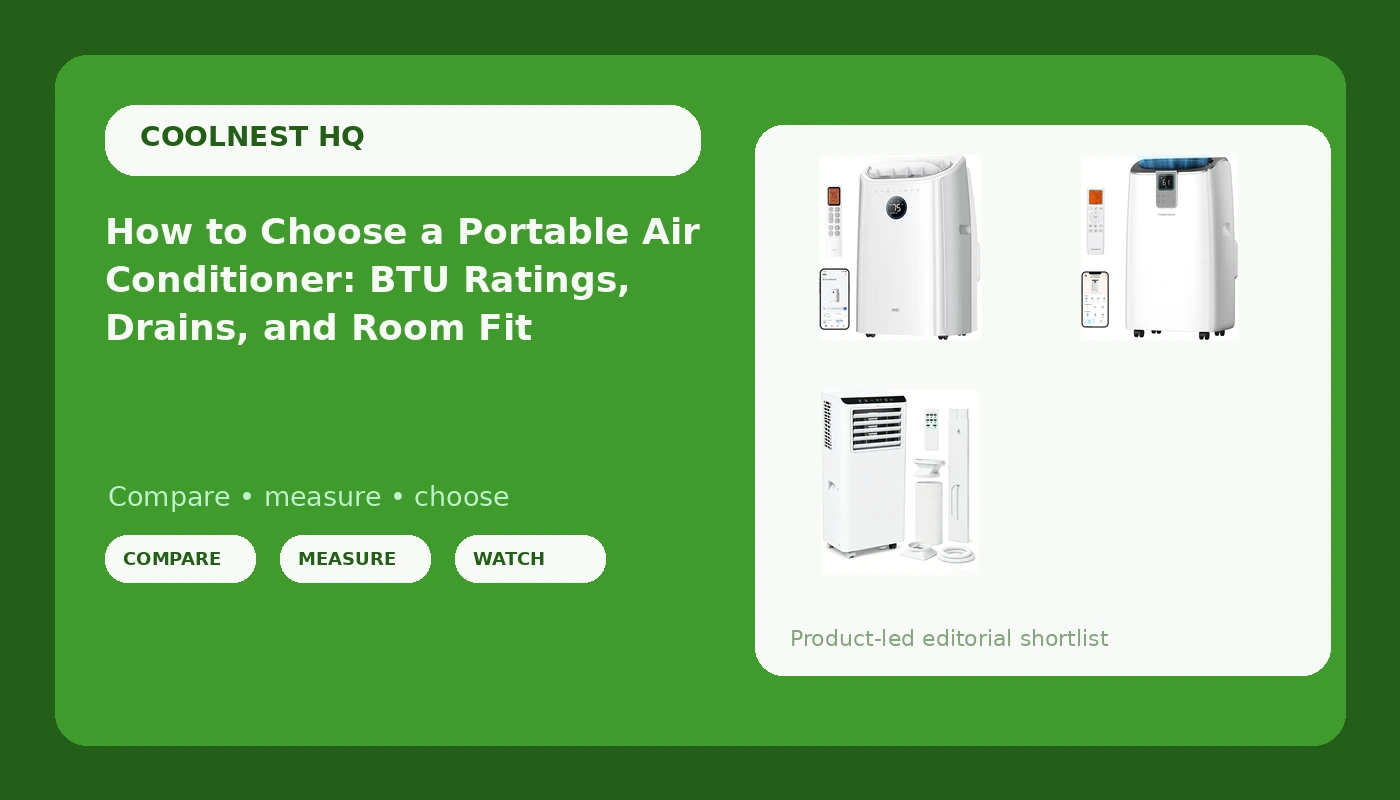
This is not a ranking. It is an explainer for the three portable air conditioner designs most shoppers end up comparing: a smart 8,000 BTU DOE bedroom unit with drainage-free cooling, a 14,000 BTU 4-in-1 unit with WiFi for larger spaces, and an 8,000 BTU unit built around basement and bedroom use with auto evaporation. By the end, you should know which of those descriptions matches your room, and why.
Related: Portable AC Sizing: How Many BTU Do You Actually Need? →
Quick answer
Size the unit against the DOE rating when the listing gives you one, not the larger ASHRAE number on the front of the box, and decide where the water goes before you buy. For a bedroom, put drainage-free cooling and app or remote control at the top of the list, because those are the two things you interact with every night. For a larger or open room, start with the higher-capacity 14,000 BTU unit and expect to manage more heat and more moisture. For a basement, or a room the listing rates up to about 350 square feet, an 8,000 BTU unit with auto evaporation is the simplest of the three to live with.
Three useful options
| Model | Best fit | What stands out |
|---|---|---|
| DREO Portable Air Conditioner 515S | Bedroom and small rooms | Listed at 12,000 BTU ASHRAE / 8,000 BTU DOE with drainage-free cooling and 3-in-1 AC, fan, and dehumidifier modes |
| 14,000 BTU Portable Air Conditioner, 4-in-1 Smart AC with WiFi | Larger rooms and open living areas | Highest listed capacity of the three, with 4-in-1 operation and WiFi control |
| 8,000 BTU Portable Air Conditioners, Portable AC Unit for Basement & Bedroom | Basements and rooms up to roughly 350 sq ft | Auto evaporation, sleep mode, and a remote in the most straightforward configuration |
The bedroom pick: DREO Portable Air Conditioner 515S
The case for this one in a bedroom is not raw capacity, it is the list of annoyances it removes. Drainage-free cooling means the unit is designed to deal with the water it pulls out of the air as part of normal operation rather than parking it in a tank you have to monitor. In a bedroom that matters more than a spec sheet figure, because the classic middle-of-the-night failure of a portable AC is not that it is slightly underpowered, it is that it starts complaining because a reservoir filled up while you were asleep.
The 3-in-1 layout, cooling plus fan plus dehumidifier, also keeps the same cabinet useful when the worst heat breaks but the humidity does not. App, voice, and remote control are worth more than they sound. A portable AC lives on the floor, usually at the end of the bed or behind a chair, and its own control panel is not something you want to crawl toward after lights out.
The trade-off is capacity. The listing carries both numbers, and the DOE figure is the one to size against, which means this is a bedroom and small-room unit rather than a whole-open-floor unit. If your space is big and open to a hallway or kitchen, move up the list.
The larger-room pick: 14,000 BTU Portable Air Conditioner, 4-in-1 Smart AC with WiFi
Capacity is the whole point here, and capacity is also the reason this unit asks more of you. A portable AC that moves more heat also moves more air, which means a larger exhaust volume, a heavier cabinet, and a window kit that has to be installed properly or the extra capacity leaks straight back outside. The 14,000 BTU figure is the marketing-side number, and it is the right one to compare against other 14,000 BTU portables, but it should not be read as a direct multiple of a DOE-rated small unit.
WiFi control earns its place on a unit this size for a practical reason: it is not going to be sitting within arm's reach of the couch. Being able to start it before you get home, or drop it into a lower setting without getting up, is the difference between using the machine and resenting it.
The honest trade-off is that bigger is not automatically better for a bedroom. A high-capacity unit short-cycling in a small, well-sealed room is a worse experience than a properly sized smaller one, and it will generally be louder and heavier to move. Buy the capacity your room needs, not the capacity that sounds impressive.
The basement and value pick: 8,000 BTU Portable Air Conditioners, Portable AC Unit for Basement & Bedroom
Basements are the most misunderstood rooms for portable cooling. They are usually the coolest space in the house by air temperature and the most humid, which means the sensible cooling load is modest while the moisture load is high. Auto evaporation is the feature that matters most here, because a dehumidifying unit in a damp basement is the exact scenario where a condensate tank fills fastest.
Sleep mode and a remote round out the practical case for a bedroom as well, though remote controls that need a clear line of sight are a recurring annoyance with portable units generally, so treat the remote as a convenience rather than a guarantee.
The trade-off is headroom. The listing rates this unit for rooms up to about 350 square feet, and that is the boundary to respect. Push it into a large open living area and you will get air movement without the temperature drop you were hoping for. In a basement bedroom, a small office, or a modest bedroom, it is the least complicated of the three to set up and run.
Prices and availability may change. Product images, names, and retailer links are matched to verified listings. No current price, rating, stock status, or measured result is stated here without current evidence.
What the BTU number on the box actually means
Portable air conditioners carry two different BTU figures, and the gap between them is the single biggest source of buyer confusion. The larger number is the ASHRAE rating, measured under standardized test conditions that do not fully account for the heat a single-hose portable drags back into the room it is trying to cool. The smaller number is the DOE rating, often labeled SACC, introduced because the marketing figure and the real-world performance had drifted so far apart.
You can see both numbers on one of the listings above: 12,000 BTU ASHRAE and 8,000 BTU DOE on the same machine. That is not a typo or a downgrade. It is the same unit described by two different test methods, and the DOE figure is the one that reflects what the appliance can do in a normal room.
The practical rule is simple. Compare DOE ratings to DOE ratings and ASHRAE ratings to ASHRAE ratings, never across the two. When a listing only gives one number, check which standard it follows before you decide a unit is more powerful than another. A 14,000 BTU ASHRAE portable is not equivalent to a 14,000 BTU DOE portable, and a listing that only advertises the bigger figure is telling you which number it prefers you to notice.
Hose design, condensate, and noise
Three physical realities separate a portable AC that works from one that becomes a garage ornament.
Hose design comes first. A single-hose portable pulls air from the room you are cooling, uses it to carry heat out the window, and dumps it outside. That air has to be replaced, and it gets replaced by hot outdoor air leaking in through every gap in the house. A dual-hose design pulls in outdoor air for the condenser side and sends it back out, so it is not fighting the pressure imbalance it created. This is why a single-hose unit above roughly 10,000 BTU tends to disappoint.
Condensate is second. An air conditioner removes water from the air as it cools. Some designs re-evaporate that water and send it out with the exhaust, which is what drainage-free and auto evaporation mean on the listings above. Others collect it in a tank or require a gravity drain hose. Neither approach is wrong, but you need to know which one you are buying, because a tank that fills overnight is a maintenance job and a gravity drain needs somewhere downhill to go.
Noise is third, and it is a specification, not a matter of taste. Compressor cycling, fan speed, and cabinet vibration all show up as decibels in a bedroom at 2 a.m. Check whatever sound figure the listing provides and treat the return window as part of the product.
- Measure the room, note ceiling height, and count the heat sources: people, electronics, west-facing glass.
- Find the DOE or SACC rating where the listing provides one, and size against that number rather than the ASHRAE figure.
- Confirm the hose design and check that the window kit fits your actual window type and width.
- Decide where the water goes: re-evaporation, a gravity drain, or a tank you are willing to empty.
- Check the noise figure and the return policy before committing to sleeping in the same room as it.
Placement, drains, and the details that decide it
- Keep the exhaust hose as short and as straight as the window kit allows, because every bend and extra foot costs you cooling.
- Seal the window kit opening with the provided panels or foam, since an unsealed gap hands your cold air straight to the outdoors.
- Do not oversize a bedroom. A unit that cools a small room quickly and then cycles off is easier to live with than one that never gets the chance to settle.
- Give the unit clearance on all sides for intake and exhaust, and never block the rear grille against a wall or curtain.
- Clean or rinse the filter on the schedule the manual specifies, because a clogged filter is the most common cause of a portable AC that suddenly stops keeping up.
- Plan the shoulder season. A unit with fan and dehumidifier modes stays useful in humid, mild weather when cooling is not needed.
Which option should you choose?
Choose the DREO Portable Air Conditioner 515S when the room is a bedroom or a small space, you want drainage-free cooling and app or voice control, and you would rather size against the 8,000 BTU DOE figure than chase a bigger headline number. Choose the 14,000 BTU Portable Air Conditioner, 4-in-1 Smart AC with WiFi when the space is larger or open to other rooms, you need the highest listed capacity of the three, and WiFi control is worth having on a unit that will not sit within reach. Choose the 8,000 BTU Portable Air Conditioners, Portable AC Unit for Basement & Bedroom when you are cooling a basement or a room the listing rates up to about 350 square feet, and auto evaporation plus sleep mode matter more to you than maximum capacity.
None of these three is described here as the quietest, the most efficient, or the best overall, because that kind of claim needs measured evidence rather than a listing. The capacities, modes, and features above come from the product listings. Real results still depend on your insulation, your window fit, how much sun the room gets, and how humid your climate is.
The bottom line
A portable air conditioner is a compromise machine, and the compromise goes better when you pick the right compromise. Size against the DOE or SACC rating, know whether the hose design is single or dual, and settle the condensate question before the unit arrives rather than at 2 a.m. on the first hot night.
If you are cooling a bedroom and want the machine to handle its own water, the DREO 515S is the one built around that job. If you are cooling something bigger and open, the 14,000 BTU 4-in-1 unit gives you the most listed capacity of the three. If you are cooling a basement or a room up to roughly 350 square feet and want the simplest setup, the 8,000 BTU unit with auto evaporation and sleep mode is the sensible starting point. Check current Amazon price on whichever fits, and confirm the window kit matches your window before you commit.