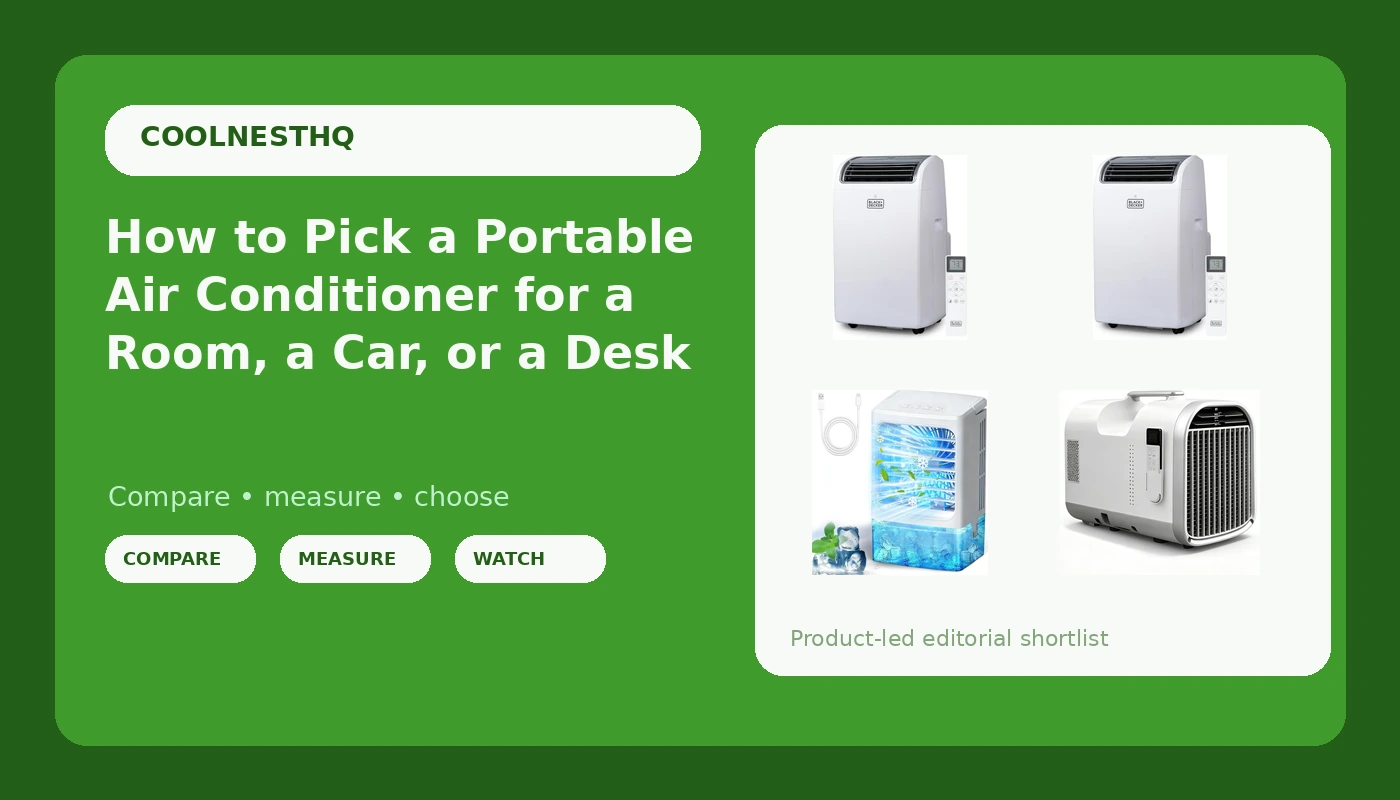
A portable air conditioner is a category label that covers at least three different machines. One is a compressor-driven refrigerant unit that behaves like a small air conditioner. One is an evaporative cooler that lowers air temperature by adding moisture, and only works well where the air is already dry. One runs on 12 volts and is built for a vehicle rather than a house. The four units below represent all three, and the most expensive mistake in this category is buying the wrong type for the space you have. This guide explains what each design can and cannot do, what the BTU number on the box actually measures, and how to match a unit to a room, a desk, or a cab.
Related: Portable AC Sizing: How Many BTUs Does One Room Need? →
Quick answer
Buy a compressor-driven portable air conditioner when you need to cool one room, you cannot install a window or central unit, and you have a window, door, or wall you can vent an exhaust hose through. If a window unit fits that same room, it will generally cool it with less electricity, so treat a portable as the fallback rather than the default. If the space is a truck cab, an RV, or a tent, you need the 12-volt type. If the space is dry and you want spot cooling at a desk rather than a cooler room, an evaporative unit is the simpler tool. Match the machine type to the space before you compare capacity or features.
Four useful options
| Model | Best fit | What stands out |
|---|---|---|
| BLACK+DECKER Smart Portable Air Conditioner, 14,000 BTU, BPACT14WT, White | A bedroom or living room with a window or door you can vent through | Manufacturer-listed 14,000 BTU portable with smart controls |
| BLACK+DECKER Smart Portable Air Conditioner with Heat, 14,000 BTU, White | The same rooms, plus shoulder-season heating | Adds a heating mode to the cooling function |
| Mini Air Conditioner Small Portable AC Unit Portable Air Conditioners with 1500ml spray/hour 3 Speed Wind & 7 Colorful LED Light Cool Mist &Timer Evaporative Air Cooler for Bedroom/Home/Office | A desk, nightstand, or small dry room | Evaporative design with a listed 1500 ml per hour mist rate, three speeds, timer, and LED lighting |
| Portable Car Air Conditioner 12V Mini AC Unit for RV Truck Camping Travel | Truck cabs, RVs, and camping setups with a 12-volt supply | Runs on vehicle power instead of a household outlet |
For a room: BLACK+DECKER Smart Portable Air Conditioner, 14,000 BTU, BPACT14WT, White
Capacity is where most buyers get confused. A portable rated at 14,000 BTU on the box is rated differently under the current federal test procedure, which reports a seasonally adjusted cooling capacity that accounts for the heat a portable pulls back in through its own cabinet and hose. That figure is usually lower than the sticker number, and it is the one to compare against other portables. It is also worth remembering that a portable has to exhaust hot air somewhere. If the hose is not connected to a window, a door panel, or a wall port, the unit is moving heat around the room rather than out of it.
For year-round use: BLACK+DECKER Smart Portable Air Conditioner with Heat, 14,000 BTU, White
The trade-off is straightforward. You are buying a second mode of operation in the same cabinet, and heating output from a portable heat pump falls off as outdoor temperatures drop, so it is not a replacement for a furnace in a hard-winter climate. In a mild-winter market it can carry a room through the shoulder seasons and save you from running a separate space heater. If you only ever need cooling, the heating model is capability you will not use.
For a desk or a small dry room: Mini Air Conditioner Small Portable AC Unit Portable Air Conditioners with 1500ml spray/hour 3 Speed Wind & 7 Colorful LED Light Cool Mist &Timer Evaporative Air Cooler for Bedroom/Home/Office
Here is the part that matters: an evaporative cooler does not work like an air conditioner. It lowers the temperature of the air it blows at you by evaporating water into that air stream, which means it raises the humidity in the room. In a dry climate that is a real benefit, and swamp cooling is a legitimate way to take the edge off a room. In a humid climate it is far less effective, because the air is already close to saturated and cannot take on much more moisture. It also needs refilling, and it will not bring down the temperature of an entire room the way a compressor unit does.
For a vehicle: Portable Car Air Conditioner 12V Mini AC Unit for RV Truck Camping Travel
The 12-volt detail changes everything about how you use it. There is no standard wall plug, so the unit depends on a vehicle battery and charging system, and how long you can run it depends on how much power that system can supply while the engine is off. It is built to cool a small, enclosed space, which means a cab or a small camper rather than a bedroom. If you want to cool a room at home, this is the wrong tool. If you want to sleep in a truck or a camper in July, it is the only one of the four built for that job.
Prices and availability may change. Product images, names, and retailer links must be matched by verified ASIN. Do not state a current price, rating, stock status, or measured result without current evidence.
What the BTU number on the box actually means
Portable air conditioner capacity is reported two different ways, and the difference matters. For years, manufacturers advertised a BTU figure describing the compressor's output under favorable conditions. In 2020 the Department of Energy changed the test procedure for portable air conditioners to a seasonally adjusted cooling capacity, or SACC, which accounts for the fact that a portable sits inside the room it is cooling and loses some of its work to heat that leaks back in through the cabinet and the hose. The practical result is that a unit advertised at 14,000 BTU typically carries a SACC rating well below that number.
What that means for a buyer: compare SACC to SACC, not sticker to sticker, and treat a listing that only quotes the older figure as incomplete. A rough sizing rule of thumb is about 20 BTU of real cooling per square foot of floor area in a normally insulated room, then adjust upward for a west-facing window, a kitchen, or a room above a garage. A portable that is far oversized for the room is not a better purchase, because it will cycle on and off, which removes less humidity and leaves the room feeling clammy.
Four designs that share one shelf
Once you know the capacity, the next question is design, and this is where portables get mis-sold.
A single-hose portable pulls air from the room, pushes it across the condenser coil, and exhausts it out the window. That creates negative pressure in the room, which pulls hot outdoor air back in through every gap you have. It is the simplest design to build and the least efficient to run.
A dual-hose portable uses one hose to bring outdoor air in for the condenser and a second hose to push it back out. It does not depressurize the room, and it generally cools better for the same compressor work. When two portables of similar capacity are otherwise close, the dual-hose unit is usually the better buy.
An evaporative cooler has no compressor and no exhaust hose at all. It adds moisture to the air and relies on dry conditions to make that work. It is a spot cooler.
A 12-volt unit is a small refrigerant system built around a vehicle's electrical supply. It is the right answer for a cab and the wrong answer for a house.
- Measure the room, including ceiling height, and note how much of the day it takes direct sun.
- Confirm a vent path: a double-hung window, a sliding door with a panel kit, or a wall port. No vent path means no portable air conditioner.
- Check the circuit. A full-size portable draws enough current that sharing an outlet with a microwave, a hair dryer, or another cooling unit can trip a breaker.
- Decide how condensate will be handled. Some units evaporate it through the condenser, some need a gravity drain, and some fill a bucket you have to empty. In a humid climate, plan on a drain hose.
- Decide where the noise will land. A unit in a bedroom has to be tolerable at night, which is a different bar than tolerable while you are watching television.
Matching the machine to the room
- If a window unit fits the room, use one. It keeps the compressor, the noise, and most of the heat outside the conditioned space.
- Buy for the SACC rating, and be skeptical of any listing that does not publish one.
- Do not buy an evaporative cooler for a humid climate. It will add moisture without delivering much cooling.
- Do not buy a 12-volt unit for a house. It is built around a vehicle electrical system, not a wall outlet.
- Plan the drain before you plan the furniture arrangement. A bucket that fills every few hours turns a cooling purchase into a chore.
Which option should you choose?
Choose the BLACK+DECKER Smart Portable Air Conditioner, 14,000 BTU, BPACT14WT, White when you need to cool one room, you can vent a hose to the outside, and cooling is the only job you need done. Choose the BLACK+DECKER Smart Portable Air Conditioner with Heat, 14,000 BTU, White when that same room also needs heat in the shoulder seasons and you would rather run one appliance than two. Choose the Mini Air Conditioner Small Portable AC Unit Portable Air Conditioners with 1500ml spray/hour 3 Speed Wind & 7 Colorful LED Light Cool Mist &Timer Evaporative Air Cooler for Bedroom/Home/Office when you want spot cooling at a desk in a dry climate and you understand that it is an evaporative cooler rather than a compressor air conditioner. Choose the Portable Car Air Conditioner 12V Mini AC Unit for RV Truck Camping Travel when the space is a cab, an RV, or a tent with a 12-volt supply, not a room.
This article describes product types and how to evaluate them. Capacity figures, features, and model details come from the manufacturer's listings and can change, so confirm the current specification and the venting requirements on the product page before you buy. Nothing here replaces measuring your own room and checking your own electrical circuit.
The bottom line
The portable air conditioner market rewards a buyer who knows two things: what type of machine they are looking at, and how much real cooling their space needs. The two BLACK+DECKER units are compressor-driven portables for a room that can be vented, with the heat model adding a second season of use. The mini unit is an evaporative cooler for a desk in dry air. The 12-volt unit is for a vehicle. Get the type right, compare SACC ratings rather than box BTU, plan the vent and the drain, and the rest of the decision is straightforward.