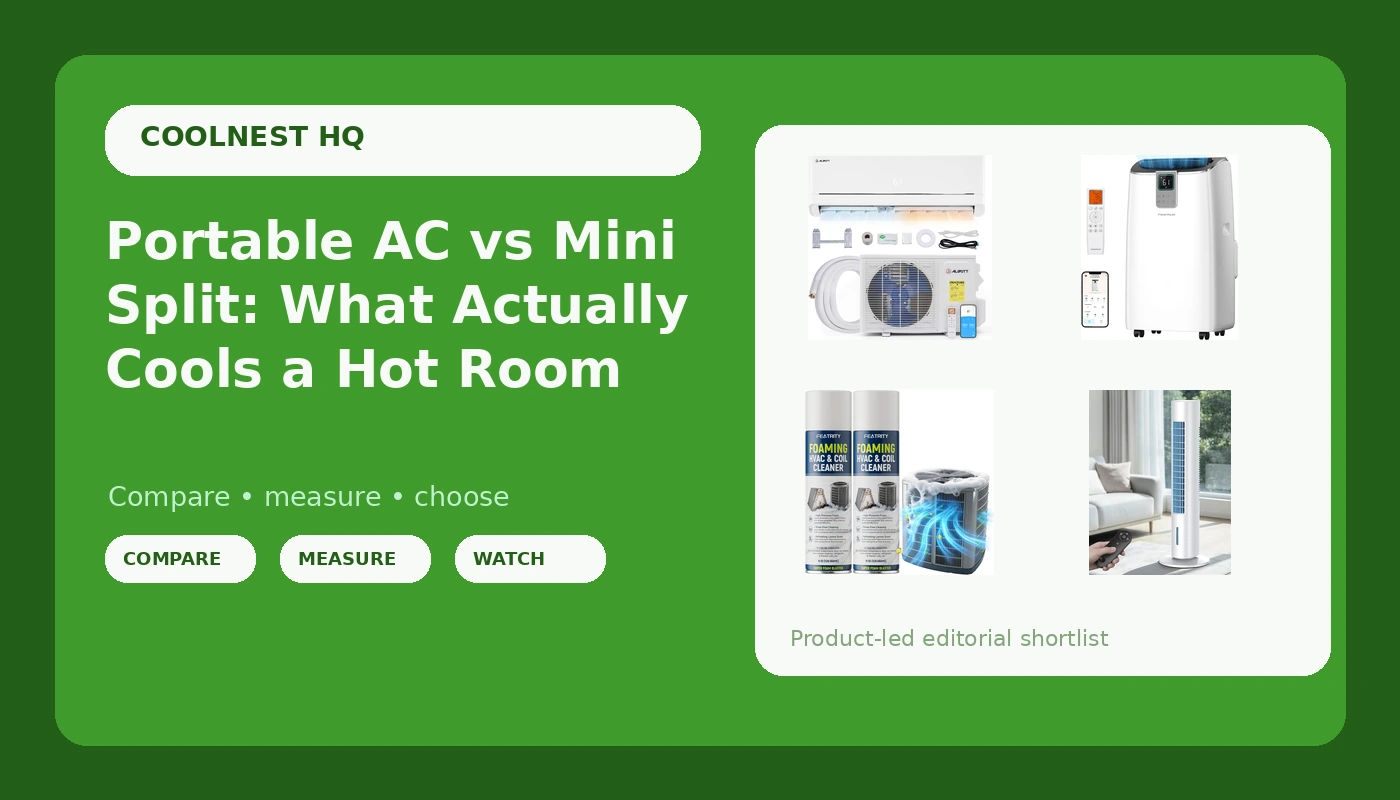
Every summer the same call comes in. A bedroom is 88 degrees at midnight, the central system is limping, and the landlord will not replace it this month. That is where the portable AC vs mini split question shows up, because those are the two paths that do not require a window that opens the right way or a contractor on the calendar.
The catch is that the labels on these boxes do not mean what most people assume. A unit advertised at 12,000 BTU and a mini split rated at 12,000 BTU are not the same machine, and one product in this category does not use a compressor at all. This is an explainer, not a shootout. Below are four products, what each one actually is, and the situations each one fits.
Related: How to Size a Portable AC for a Bedroom Without Guessing →
Quick answer
If you can mount an indoor head and place a condenser outside, a ductless mini split is the more efficient way to move heat out of a room, because it never dumps conditioned air outdoors to make room for hot air. If you cannot mount anything, a portable compressor unit is the practical fallback, and dual-hose designs avoid the worst of the efficiency loss. An evaporative cooler is a different machine: it cools by adding moisture to the air, so it only works in dry climates and it is not a substitute for a compressor air conditioner. Coil cleaner is not cooling equipment at all. It is maintenance for whatever you already own.
Four useful options
| Model | Best fit | What stands out |
|---|---|---|
| Albott 12,000 BTU Mini Split Air Conditioner and Heater SEER2 18, 115V | Rooms where an indoor head can be mounted and a condenser can sit outside | Listed as a 12,000 BTU system with a SEER2 18 rating, 115V power, and both cooling and heating |
| 14,000 BTU Portable Air Conditioner, 4-in-1 Smart AC with WiFi | Rentals and rooms where nothing can be permanently mounted | A 14,000 BTU portable with a four-in-one function set and WiFi control |
| Windowless Portable Air Conditioners, 35" Evaporative Air Cooler w/3 Speeds&3 Modes, 25ft Remote&Smart Timer, 120°Oscillating Portable AC Unit, Swamp Cooler Air Conditioner for Bedroom Indoor | Dry climates and spaces where you want moving air without a compressor | A 35 inch tower with 3 speeds, 3 modes, 120 degree oscillation, a remote rated to 25 ft, and a smart timer |
| Foaming AC Coil Cleaner: 38oz for Evaporators & Condensers | Annual upkeep on any air conditioner you already run | A 38 oz foaming formula labeled for both evaporator and condenser coils |
The permanent option: Albott 12,000 BTU Mini Split Air Conditioner and Heater SEER2 18, 115V
The trade-off is installation. A mini split needs a mounting location for the indoor head, a path through a wall for the line set and drain, and outdoor space with clearance for the condenser. That is more work than rolling a portable into a corner, and it is the one option here that changes the room permanently. In exchange, you stop fighting the physics that make single-hose portables inefficient, and the SEER2 18 rating is a genuine efficiency figure rather than a marketing capacity number.
The portable option: 14,000 BTU Portable Air Conditioner, 4-in-1 Smart AC with WiFi
Portables come with conditions. You still need a window or slider for the exhaust, and how that exhaust is plumbed decides whether the unit is efficient or self-defeating. You also need to think about condensate, because a unit that fills a tank every few hours turns into a chore. And the capacity number deserves scrutiny: portable ratings are the ones most affected by the difference between a marketing BTU figure and a tested rating, which is covered further down.
The dry-climate option: Windowless Portable Air Conditioners, 35" Evaporative Air Cooler
This is the one product in the group that is not a compressor air conditioner, and the name calling it a swamp cooler is the honest part. Evaporative cooling works by adding moisture to dry air, which is why it performs in the desert and disappoints in humid climates, where it mostly adds mugginess. It also needs airflow through the space to work, so a sealed bedroom with the door shut is the wrong application. Treat it as a spot cooler and air mover, not as a replacement for refrigerant cooling.
The maintenance option: Foaming AC Coil Cleaner: 38oz for Evaporators & Condensers
Cleaning is not glamorous, but it is the cheapest capacity you will ever recover. Follow the label directions, protect electronics and surrounding surfaces, and rinse thoroughly. A mini split head, a portable's intake coil, and an outdoor condenser all collect dust and lint over a season. What a coil cleaner will not do is fix a refrigerant charge problem, a failing capacitor, or a unit that was undersized for the room in the first place.
Prices and availability may change. Product images, names, and retailer links must be matched by verified ASIN. Do not state a current price, rating, stock status, or measured result without current evidence.
What the BTU number on the box actually means
BTU is a unit of heat, not a promise. Two machines can both claim 12,000 BTU and move very different amounts of heat out of your room, because the testing behind the number is not the same for every product category.
Portables are the worst offenders. The DOE changed the rating standard in 2020, and the tested figure for a portable is typically well below the capacity printed on the marketing panel. That tested figure accounts for the fact that a portable sits inside the room it is cooling and has to deal with its own heat load. When you see a portable advertised at 14,000 BTU, treat that as the manufacturer's capacity claim, and expect the real working number to be lower.
Mini splits are rated differently. Capacity and efficiency figures for ductless systems come from a testing framework that includes the SEER2 efficiency rating, which is why a SEER2 18 number tells you something concrete about how much electricity the system uses per unit of cooling. A mini split's 12,000 BTU and a portable's 12,000 BTU are not the same claim.
Evaporative coolers have no BTU rating at all, because there is no compressor and no refrigerant. Their performance depends on outdoor humidity and airflow, which is why a swamp cooler that works in Phoenix can be useless in Houston.
How to choose, in five steps
- Confirm where the heat goes. A mini split needs an outdoor condenser location. A portable needs a window or slider for exhaust. An evaporative cooler needs an open path for air and a dry climate.
- Size for the room and the sun load, not for the biggest number on the shelf. A west-facing bedroom with a bad window gains more heat than the square footage alone suggests.
- Decide how condensate gets handled before you buy. A unit that needs a tank emptied constantly is a unit you will stop using. Look for a continuous drain option or a hose connection.
- Check your power. The Albott system runs on 115V, which is convenient, but any large cooling appliance deserves a look at the circuit it will share.
- Decide whether you need heat and how much noise you can tolerate at night. A bedroom unit that keeps you awake has failed at its job even if the temperature is right.
Practical setup and maintenance notes
- Seal the window kit. A sloppy exhaust installation lets hot outdoor air straight back into the room.
- Keep hose runs short, straight, and insulated where possible, because every bend and every foot costs you capacity.
- Give any condenser or outdoor unit clearance for airflow, and keep it out of direct afternoon sun if you can.
- Clean coils at the start of the season. Foaming cleaner on the evaporator and condenser is cheap compared with a service call.
- For evaporative cooling, leave a door or window cracked. A swamp cooler in a sealed room just raises the humidity.
Which option should you choose?
Choose the Albott 12,000 BTU Mini Split Air Conditioner and Heater SEER2 18, 115V when you own or control the space, can mount an indoor head, and have somewhere for a condenser. Choose the 14,000 BTU Portable Air Conditioner, 4-in-1 Smart AC with WiFi when you rent, move the unit between rooms, or cannot cut a wall. Choose the Windowless Portable Air Conditioners, 35" Evaporative Air Cooler when you live in a dry climate and want moving air without a compressor or a window kit. Choose the Foaming AC Coil Cleaner: 38oz for Evaporators & Condensers when the cooling equipment you already own is due for its annual cleaning.
One caveat applies to all four. Capacity claims, efficiency ratings, and function lists here come from the product listings, not from independent testing, and portable capacity ratings in particular should be treated as a starting point rather than a measurement.
The bottom line
The portable AC vs mini split decision is really a decision about your walls and your window. If you can install a ductless system, you get quieter operation, better efficiency, and no exhaust hose fighting you. If you cannot, a portable compressor unit is the honest compromise, and an evaporative cooler is a different tool for a different climate. Whichever way you go, budget for coil cleaning and think hard about where the water goes, because those two details decide whether the machine is still in use come August.