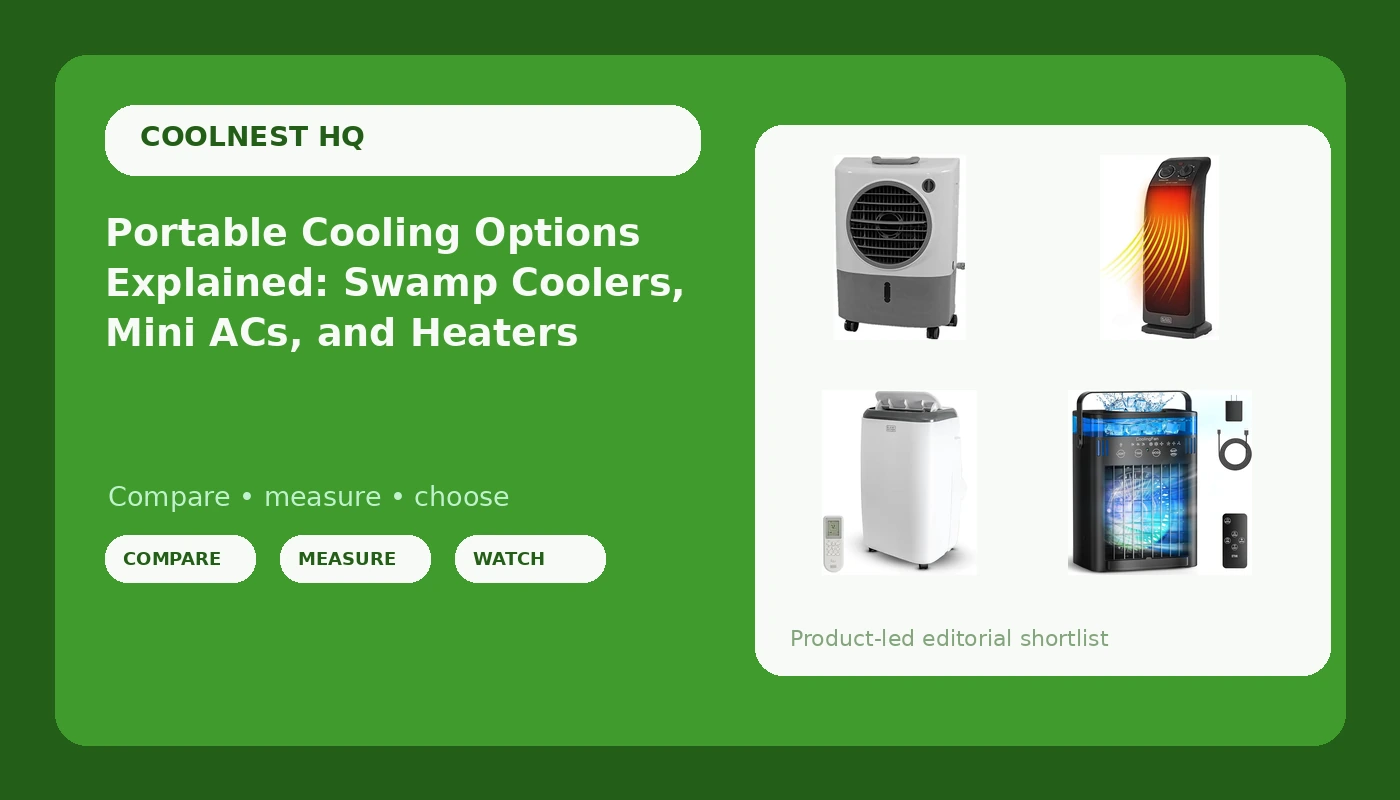
Portable cooling options get sold as if they were interchangeable, and they are not. A compressor air conditioner, an evaporative cooler, a desktop misting fan, and a ceramic tower heater are four different machines that share one shelf and almost nothing else. The useful question is never which one wins overall, it is which one fits the room you have, the climate you live in, and the window, vent, or outlet you can actually use.
That is the entire point of this explainer. Below are four currently listed products, what their spec sheets claim, and where each design tends to disappoint. No invented test results and no prices, just the numbers on the label and what those numbers mean once a unit is running in a real room.
Related: How to Size a Portable AC for a Bedroom →
Quick answer
There is no single best portable cooling product in this group, because the four devices do different jobs. The BLACK+DECKER 7,500 BTU portable air conditioner is the only one here with a refrigerant compressor, so it is the one to pick when a bedroom or office needs to be genuinely cooled and dehumidified and you can run an exhaust hose. The Hessaire MC18M evaporative cooler moves the most air and suits dry climates and open spaces. The mini desktop unit is a personal cooler for one person at a desk. The BLACK+DECKER tower heater covers the months when cooling is not the problem at all. Match the device to the room before you compare anything else.
Four useful options
The table is a starting point, not a ranking. Each row describes the job the product was built for.
| Model | Best fit | What stands out |
|---|---|---|
| BLACK+DECKER Portable Air Conditioner, 7,500 BTU, BPT05WTB, White | A bedroom or office with a way to exhaust a hose | 7,500 BTU rated compressor unit that cools and dehumidifies |
| Portable Swamp Coolers, 1300 CFM MC18M Evaporative Air Cooler by Hessaire | Dry climates, garages, patios, open rooms | 1,300 CFM airflow rating, 2-speed fan, 53.4 dB, 500 sq ft coverage rating |
| Portable Air Conditioner Mini Desktop AC Fan with Remote, 1000ml Water Tank | One person at a desk or nightstand | 3 wind speeds, 3 mist levels, 2 to 8 hour timer, 7 LED light modes |
| BLACK+DECKER Oscillating Ceramic Tower Heater, 1500 Watts, BHTC571, Black | Shoulder season and winter spot heat | 1,500 watts of ceramic heat with an oscillating tower design |
The compressor pick: BLACK+DECKER Portable Air Conditioner, 7,500 BTU, BPT05WTB, White
This is the only unit in the group that removes heat from a room instead of just moving air around. That distinction matters more than any other specification on this page. A compressor portable pulls warm air across an evaporator coil, dumps the heat into the exhaust stream, and sends it out a hose, which means it also pulls moisture out of the air as condensate.
The trade-off is installation and drainage. You need a path for that hose, usually a window or a sliding door with a panel kit, and you need a plan for the water the unit collects. Some portables evaporate most of their condensate back into the exhaust stream, others fill a tank or need a gravity drain. Read the manual for the specific model before you assume either way. The other caveat is that a 7,500 BTU portable is a small-room machine. It is not a substitute for central air in an open floor plan.
The dry-climate pick: Portable Swamp Coolers, 1300 CFM MC18M Evaporative Air Cooler by Hessaire
An evaporative cooler does not use a compressor, and that is the whole story. It pulls outside air through a wet pad and delivers it indoors, so its cooling power depends on how dry the incoming air is. Where relative humidity is low, the temperature drop across the pad is real and noticeable. Where humidity is high, the same machine adds moisture to a room that already has too much and the cooling effect collapses.
That is why the rating you care about here is CFM, not BTU. Airflow moves the cooled air to you, and 1,300 CFM is a lot of movement for a portable box. It also means the unit is a fit for a garage, a covered patio, or a workshop where a window unit cannot go and where doors and windows stay open for cross-ventilation. If you close it in a sealed bedroom on a humid day, you will be disappointed. The 53.4 dB figure is roughly the level of a normal conversation, which is fine for a shop and noticeable in a bedroom.
The desk pick: Portable Air Conditioner Mini Desktop AC Fan with Remote, 1000ml Water Tank
Set expectations correctly here and this category makes sense. A unit like this is a fan with a water tank, not a compressor air conditioner, and the "AC" in the listing describes the form factor rather than a refrigeration cycle. What it does is blow air across a fine mist, which cools your skin and the immediate air around you.
The useful spec is the tank, and 1,000 ml is generous for a desktop unit. It means fewer refills over a workday than the small 300 ml tanks common in this category, though how long it actually lasts depends on which mist level you run. The timer and the LED modes are convenience features for a nightstand. None of that will drop the temperature of a bedroom, and the remote, like most compact remotes, needs a reasonably clear line of sight. Buy it as spot cooling for one person and it does its job.
The shoulder-season pick: BLACK+DECKER Oscillating Ceramic Tower Heater, 1500 Watts, BHTC571, Black
This is in the guide because a portable cooling setup is a seasonal purchase, and the same corner of the room that needs cooling in July needs heat in January. A 1,500 watt ceramic heater is the standard ceiling for a plug-in space heater on a 120 volt household circuit, and it draws about 12.5 amps while running. That is most of a 15 amp branch circuit, so it should not share an outlet or a circuit with a portable air conditioner, a microwave, or anything else that pulls hard.
Oscillation helps in a small room because it spreads the hot air column instead of concentrating it on one spot. Ceramic elements also tend to reach temperature quickly, which suits a bathroom, an office, or a bedroom during the hour before sleep. It is a spot heater, not a furnace replacement, and it will not warm a whole house.
Prices and availability may change. Product images, names, and retailer links must be matched by verified ASIN. Do not state a current price, rating, stock status, or measured result without current evidence.
What the numbers on the box actually mean
Three different units of measurement show up in this group, and comparing across them is where most buyers go wrong.
BTU is a measure of heat removed per hour, so it only applies to the compressor air conditioner. Since the 2020 DOE test standard, portable air conditioners are rated in SACC, a number that is usually well below the old marketing BTU figure on the same box. That gap is why a unit advertised at a large number can struggle in a bedroom. When you compare two portables, compare SACC to SACC, not sticker to sticker.
CFM is airflow in cubic feet per minute, and it is the number that matters for the evaporative cooler. Cooling there comes from evaporation, which depends on the difference between the dry bulb and wet bulb temperature of the incoming air. High airflow plus dry air equals a real temperature drop. High airflow plus humid air equals a wet breeze.
Watts describe the heater. A 1,500 watt element converts almost all of that electricity into heat, and no plug-in space heater on a standard outlet meaningfully beats that figure. Tank volume in milliliters describes the desktop unit, and it tells you how long you can run before a refill, not how much space you can cool.
How to match a cooler to the room
- Measure the room in square feet and note how much sun it takes. Rooms under roughly 250 square feet are where portable units make sense, and a west-facing window changes the load.
- Decide whether you can exhaust air. A compressor portable needs a hose path to the outdoors. If there is no window, no sliding door, and no vent, that option is off the table before you compare anything else.
- Check your climate humidity. Below about 40 percent relative humidity, evaporative cooling works well. Above about 50 percent, it mostly adds moisture.
- Plan the drain before the first hot day. Figure out whether the unit evaporates its condensate, fills a tank, or can be gravity drained, and whether you are willing to empty it on the schedule that implies.
- Decide how loud is acceptable where you sleep. Airflow ratings and compressor noise are different problems, and a unit that is fine in a garage can be unbearable at the head of a bed.
What to check before you order
- Confirm the exhaust or venting hardware included with any compressor unit, and measure the window or door opening it has to fit.
- Check the circuit you plan to use. A 1,500 watt heater or a compressor portable plus anything else on the same 15 amp branch is asking for a tripped breaker.
- Plan where condensate goes, and whether a floor drain, a window sill, or a tank is part of that plan.
- Expect spot cooling from the desktop unit and airflow cooling from the evaporative unit, not whole-room refrigeration.
- Think about the full year, not just the hot month, and whether one purchase or two covers both seasons.
Which option should you choose?
Choose the BLACK+DECKER Portable Air Conditioner, 7,500 BTU, BPT05WTB, White when you need an actual cooled and dehumidified room and you have a way to run the exhaust hose. Choose the Portable Swamp Coolers, 1300 CFM MC18M Evaporative Air Cooler by Hessaire when you live somewhere dry and want to move a large volume of air through a garage, patio, or open workshop. Choose the Portable Air Conditioner Mini Desktop AC Fan with Remote, 1000ml Water Tank when the goal is keeping one person comfortable at a desk or bedside. Choose the BLACK+DECKER Oscillating Ceramic Tower Heater, 1500 Watts, BHTC571, Black when the season has turned and the problem is cold rather than heat.
One honest caveat: the descriptions here come from manufacturer product listings, not from bench measurements. Rated BTU, CFM, and decibel figures are manufacturer claims, and real-world performance depends on room size, insulation, sun exposure, humidity, and how the unit is vented. Treat every number on this page as a starting point for your own comparison.
The bottom line
Portable cooling is not one product category, it is four. If you need a small room genuinely cooled, the compressor unit is the only one of these that removes heat, and the hose and the drain are the two things that decide whether you will be happy with it. If you live in dry air and need to move a lot of it, the evaporative cooler is the efficient choice. If you just want your own chair to be comfortable, the desktop unit is cheap and does exactly that. And if you are shopping in September for a room that will be cold by November, the tower heater belongs on the same list. Pick by the room and the climate first, then compare specifications within the category you have chosen.